Bonnie Tyler Dies: How Total Eclipse Of The Heart Became Queer Culture's Loudest Prayer
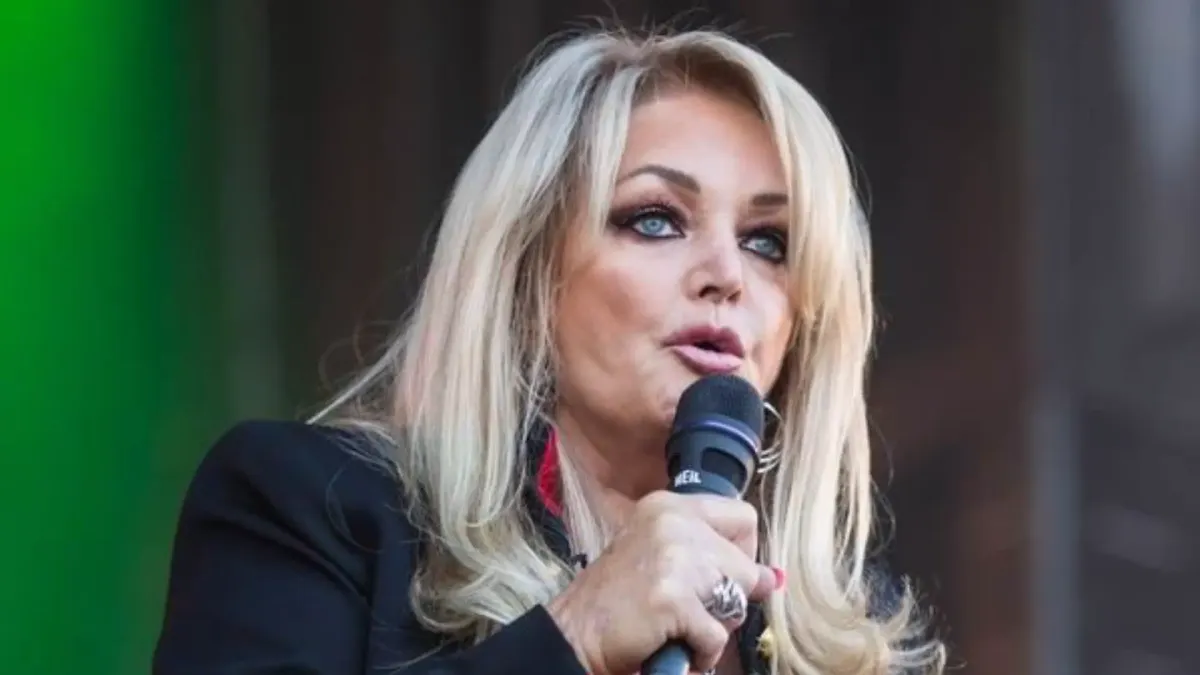
The Welsh singer, who died this week at 75, never set out to be a gay icon. She became one anyway, by doing the thing queer audiences have always recognised and rewarded: feeling everything, at full volume, without a flicker of apology.
Somewhere tonight, in a basement bar in Soho or Manchester's Canal Street or a converted chapel in Cardiff that now serves cocktails with regrettable names, somebody will queue up "Total Eclipse of the Heart" on the karaoke machine, and the room will do what rooms have done for forty three years. Conversations will stop. Strangers will lock eyes. And when the moment comes, an entire bar full of people who arrived as individuals will become, for four and a half minutes, a single choir howling "turn around, bright eyes" at nobody in particular and everybody at once. It will happen tonight because it happens every night, but tonight it will mean something different, because Bonnie Tyler has died, at 75, in a hospital in Portugal, and the queer world has lost one of its most improbable and most beloved patron saints.
Her family announced the news on Thursday morning, saying she had passed away unexpectedly following the illness she had been fighting since emergency intestinal surgery in May, an ordeal that had included a month in an induced coma near her home in Faro. She had been due to spend this summer on tour, marking fifty years since "Lost in France" first put her on Top of the Pops. That she was still gigging at 75, still planning to drag that voice around Malta and Hungary and Turkey, tells you most of what you need to know about her. Bonnie Tyler did not do retirement, in the same way she did not do restraint, understatement, or singing at anything less than the emotional register of a woman watching her house burn down while the love of her life sails away on a doomed ship.
That register is precisely why we are writing about her here.
The chapel girl with the ruined voice
To understand why queer people claimed Bonnie Tyler, you have to start with the fact that she was never supposed to sound like that. She was born Gaynor Hopkins in Skewen, near Neath, in 1951, one of six children of a coal miner, raised in a council house and marched to chapel three times every Sunday, where she gave her first public performance singing "All Things Bright and Beautiful". She left school at 16 with no qualifications, entered a local talent contest at her aunt's insistence, came second, won a pound, and decided that was evidence enough of a calling. She spent years singing in Swansea clubs before a talent scout found her in 1975, and when RCA signed her they told her to change her name, which she did by picking words out of a newspaper.
It is worth sitting with that origin story for a moment, because it belongs to a very specific and very queer-adjacent Welsh tradition, the one that also produced Shirley Bassey and Tom Jones: working-class kids from the valleys and the ports who sang like the chapel taught them, which is to say with everything, because Welsh nonconformist worship never had much time for tastefulness. Gay audiences have adored the Welsh belters for generations, and the reason is not mysterious. These are performers for whom bigness is not a costume but a first language, and queer people, who have historically been told our feelings are too much, too loud, too dramatic and too public, have always found something liberating in artists who treat too much as the correct amount.
Then, in 1977, just as "Lost in France" and "It's a Heartache" were breaking her internationally, came the accident of biology that made her a legend. Nodules on her vocal cords. Surgery to remove them. Doctors' orders to rest her voice completely for six weeks, orders she famously failed to follow. What emerged was the rasp, that magnificent ruined-cathedral of a voice, sandpaper and smoke and heartbreak, the sound of a woman who has been through something and is prepared to tell you about it at length.
There is a queer reading of that voice so obvious it barely needs stating, but this is Outcast World, so let us state it anyway. The thing that was supposed to be her flaw, the damage, the deviation from how a woman was meant to sound, became the entire point of her. The injury became the instrument. Every queer person who has ever taken the thing they were bullied for and built an identity on top of it understands Bonnie Tyler's voice at a cellular level. She did not sing despite the rasp. She sang with it, through it, because of it. It was her transition from a good singer into an unmistakable one.
Steinman, vampires, and the cathedral of camp
And then Jim Steinman got hold of her.
The story of "Total Eclipse of the Heart" is so gloriously unhinged that it deserves retelling at every opportunity. Steinman, the mad monk of American rock, the man who wrote "Bat Out of Hell" for Meat Loaf and treated every song as a Wagnerian opera compressed into seven minutes, had originally been developing the material in the orbit of a vampire musical. He later said as much himself, describing the song as a vampire love song, its working title reportedly "Vampires in Love". Tyler had gone looking for the man behind Meat Loaf's records and got, in return, the biggest-selling single of her life, a song about desperate, consuming, faintly gothic need that went to number one in the United States and made her the first Welsh artist ever to top the American charts, shifting six million copies along the way.
Watch the video again, as millions have been doing since Thursday morning. Russell Mulcahy's fever dream of a boarding school gothic, with its billowing curtains, its choirboys with glowing eyes, its doves, its ninjas, its young men in various states of undress doing interpretive movement down candlelit corridors while Bonnie wanders the halls in white chiffon looking haunted. It is one of the most sublimely camp artefacts of the entire 1980s, and here is the crucial thing, the thing on which her whole queer canonisation rests: nobody involved is joking.
Susan Sontag defined camp, in part, as a seriousness that fails, but the camp that queer audiences actually treasure, the camp of Bassey and Garland and Cher and Kate Bush and Bonnie Tyler, is something closer to a seriousness that refuses to fail, a commitment so total that it sails past embarrassment into transcendence. Tyler never winked at the camera. She never performed "Total Eclipse of the Heart" with the raised eyebrow of someone in on a joke. She sang about being a little bit lonely and a little bit terrified with the conviction of a woman delivering testimony, and she did it every night for four decades, and that sincerity is exactly what made the song safe for queer people to pour ourselves into. Irony protects the performer and excludes the audience. Sincerity does the opposite. Bonnie left the door wide open, and we walked in and never left.
Holding out for a hero, and other queer prayers
If "Total Eclipse" is her cathedral, then "Holding Out for a Hero" is her disco, and it might be the more significant queer text of the two. Written by Steinman for the Footloose soundtrack in 1984, it is, on its face, a song about wanting an impossible man, a white knight on a fiery steed, larger than life and sure and soon and stronger than anything actually on offer. It has soundtracked more drag performances than could ever be counted, a fixture of Pride main stages and cabaret basements and lip syncs from Blackpool to Berlin, and its second life via Shrek 2 delivered it to a whole generation who now request it at weddings without knowing they are participating in a queer liturgy.
Because that is what it is. A song about holding out, about refusing to settle for the diminished thing the world says you should accept, about demanding the operatic version of love or nothing at all, is a queer prayer whether Steinman meant it as one or not. Every drag queen who has ever performed it understood this instinctively. The song's hero never arrives, and it does not matter, because the point is the wanting, the audacity of wanting that much and saying so at that volume. Queer desire has spent most of history being told to make itself smaller, quieter, more apologetic. "Holding Out for a Hero" is four minutes of the exact opposite instruction.
And for the completists, there is "If You Were a Woman (And I Was a Man)", her 1986 single written by Desmond Child, a gay man and one of the great pop craftsmen of his era, a song whose entire premise is the hypothetical swapping of gender and the power that shifts with it. Bonnie Tyler was singing gender trouble on daytime radio while most of pop was still pretending we did not exist.
She never courted any of this, which is partly why it stuck. She was, by every account, a profoundly unpretentious woman, married to Robert Sullivan from 1973 until her death, a chapel girl who happened to end up fronting some of the most extravagant records ever made. When she represented the United Kingdom at Eurovision in 2013, at 61, she finished 19th and appeared to enjoy every second of the campest institution on the continent, treating the whole affair with the good humour of somebody who had long ago stopped worrying about cool. She was appointed MBE for services to music, published her autobiography, and kept touring, kept giving the songs their full weight, never once condescending to her own catalogue or to the audiences, increasingly and visibly queer ones among them, who kept turning up.
Queer Grief
There is a particular grief that attends the death of a camp icon, and it is not really grief for the person, whom most of us never met and who by all accounts lived a long, full, well-loved life doing exactly what she wanted. It is grief for a ritual keeper. Bonnie Tyler's songs are communal technology for queer people. They are what we reach for at 1am when the night needs an ending, what a drag artist reaches for when the room needs lifting, what we scream together in the moments when being individually too much becomes, collectively, exactly enough. Those rituals will continue, because that is the strange mercy of pop music: the voice outlives the singer, and the rasp that biology gave her in 1977 is now permanent, pressed into vinyl and streaming servers and the muscle memory of every gay bar sound system on Earth.
Bonnie Tyler, born Gaynor Hopkins, 8 June 1951 to 8 July 2026.