EDINBURGH FRINGE 26: The duet that strips love down to who leads
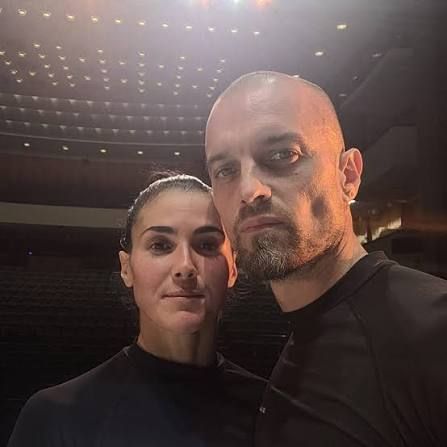
Compagnia Bellanda arrive at the Edinburgh Festival Fringe with Il canto dell'assiolo, a duet about power, tenderness and relationships that come without an instruction manual. It is not a queer show, and yet it speaks directly to anyone who has ever had to make one up as they go. Outcast World met the company.
Outcast Goes to Edinburgh! Dan Tiernan & Compagnia Bellanda
Most of the questions a relationship actually turns on are the ones nobody says out loud, and Il canto dell'assiolo, the duet that Italian company Compagnia Bellanda bring to the Fringe this month for their first ever Edinburgh, is built almost entirely from them. Who leads. When does support quietly become control. Can a gesture carry force, and can a word land harder than a hand. The piece asks all of this and then, with some deliberation, declines to answer, holding its audience inside the uncertainty for the full forty-five minutes rather than letting anyone off with a resolution.
The company is the work of Giovanni Leonarduzzi and Claudia Latini, creative partners for seven years, and its whole sensibility grows from a fact that sets it apart from most of the dance on the Fringe programme: Leonarduzzi did not come up through ballet school or a conservatoire but through breaking. He started, Latini explains, translating for him, the way almost every b-boy starts, watching someone else do it and trying to copy what he saw, and everything the company makes has been expanded outward from that base rather than layered on top of a classical training. The name Bellanda is itself a small act of belonging, drawn from the Friulian expression biele ande, which describes having a good way of moving, a style in the way you carry yourself, a phrase from their own dialect that happens to fit a dance company rather perfectly.
Where they come from matters to them, and it turns out to explain more than the name. Friuli Venezia Giulia sits in the far north-eastern corner of Italy, the last region before Slovenia, a long way from the centre of anything, and Latini traces the company's independence directly to that distance. In the early days, she says, the VHS tapes of what was happening elsewhere in the dance world arrived late, everything reaching them at a delay, and Leonarduzzi drew a lesson from it that has shaped the company ever since, which was that if he waited for the material to come to him he would always be behind, and so he had no choice but to invent his own signature, his own version of everything. It is an origin story about making your own way because the established pathway simply was not available, and it will sound familiar to a great many people who have had to build an identity without inheriting the template for it.
The show takes its name from the assiolo, the Scops Owl, a tiny migratory bird that travels up from Africa and pauses in Friuli, almost never seen and known instead by its call, a single note repeated through spring and summer nights, carrying far further than so small a creature has any right to, traditionally heard in the region as an omen that change is coming. That is the image the company reaches for, a presence you feel without ever quite catching sight of it, and Leonarduzzi is explicit that the change in question is the change inside a relationship, the moment when one person senses that something in the other has shifted, something they cannot see and cannot name but can absolutely feel, and cannot work out what is no longer the same.
Technically it is one of the more distinctive things at the Fringe this year. Microphones are placed around a playing space of barely four metres by five, catching breath, footsteps, the friction of skin on the floor and fragments of voice, and feeding all of it back into the room in real time, so that the sound does not accompany the choreography so much as alter it as it happens. Every venue becomes its own sounding box, which means, as the company points out with some satisfaction, that no two performances can ever sound the same. Language is used and then dismantled, spoken and repeated until it stops meaning anything and becomes pure rhythm, on the principle, as Leonarduzzi puts it, that you do not need to share someone's language to know when they are crying, that tone and timbre carry the emotion whether or not the words are understood.
None of which, on its face, is a queer show, and the company does not pretend otherwise. It is a duet danced by a man and a woman, and it would be the easiest thing in the world to read it as a straightforward story about the two of them. What makes it worth an Outcast World reader's evening is what the company says when that surface is set aside. Asked directly whether the piece speaks to people whose relationships do not fit the usual boxes, Latini does not hesitate: the show, she says, is about a relationship between two people, that is all, whoever they happen to be, and probably about friendship too, and about whatever other kind of bond a person lives inside, because a life is made up of relationships between two people, always oneself and somebody else, and always a matter of balancing power against tenderness and of leading or allowing yourself to be led. The fact that they are a man and a woman is, in her account, only the surface. The negotiation underneath it, the working out of who holds what and when, the refusal to reduce a whole relationship to a single tidy truth, is the terrain that queer people have very often had to map for themselves without a rulebook, which is exactly why a duet from a small corner of Italy, danced by two people who insist it is about anyone, earns its place in this coverage.
Il canto dell'assiolo runs at Assembly @ Dance Base (DB1), Grassmarket, at 8.30pm from 18 to 30 August, excluding the 24th. The work is performed in Italian with an English translation of the script available. Running time is forty-five minutes.