


Gay men are voting Reform. So what’s going on?
Here’s a stat that will either annoy you or make a lot of sense, depending on where you’re sitting.
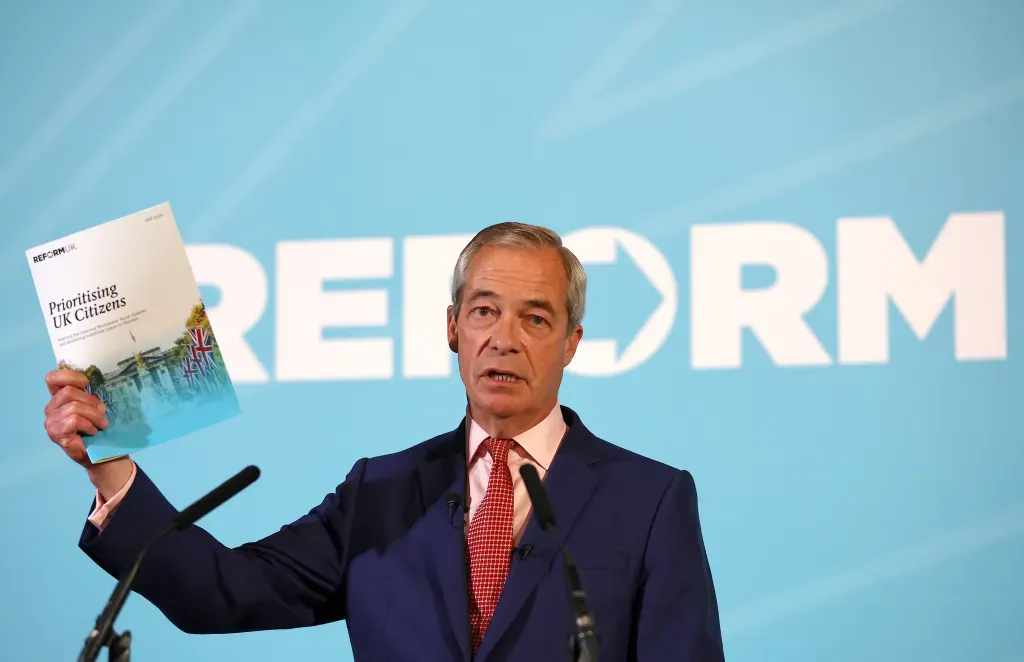
Reform UK is currently polling as the most popular party among gay and bisexual men in Britain.
That comes from a More in Common poll of nearly 9,000 adults across England, Wales and Scotland. Around 25 per cent of gay and bisexual men said they would vote for Nigel Farage’s party. The Greens were next on 19 per cent, Labour on 18, with the Conservatives and Lib Dems both on 15.
Reform is also leading among straight men and straight women. The only group where it isn’t ahead is gay and bisexual women, who are backing the Greens in much bigger numbers.
So yes, before anyone spirals, it’s worth actually looking at what this does and doesn’t mean.
First, the obvious question
Why would a quarter of gay and bisexual men support a party whose leader has said equal marriage was wrong, and whose policies include rolling back parts of the Equality Act?
That tension is real. But the answer is probably less neat than people want it to be.
This might be more about Labour than Reform
At the last general election, 41 per cent of gay and bisexual men voted Labour.
That has clearly fractured.
Some have gone to the Greens. Some to Reform. Some have just switched off entirely. That doesn’t look like a clean shift to the right. It looks more like people losing faith and scattering.
Reform is picking up part of that, but it is not the whole story.
Then there’s the uncomfortable bit
There is also a harder conversation here.
Some gay men, particularly those who feel relatively secure in their lives, may not see Reform’s culture war politics as something that directly affects them.
Anti trans rhetoric, anti DEI messaging, all of that can feel abstract if you are not the one being targeted.
That does not make it irrelevant. But it does help explain why some people are able to park it when they vote.
Whether that is short sighted or just pragmatic depends on who you ask.
And the data itself is not perfect
It is also worth saying the sample size for gay and bisexual men in this poll is relatively small.
Estimates suggest around 180 to 200 respondents, which means the margin of error is significant. Three quarters of gay and bisexual men still chose someone other than Reform.
So calling it a clear lead needs a bit of caution. In a fragmented field, 25 per cent can look bigger than it really is.
Still, something is shifting
Even with all of that, the direction of travel is hard to ignore.
Russell T Davies recently warned that the rise of Reform could mean gay rights getting worse in the UK. Meanwhile Darren Grimes, a gay Reform figure, pushed back by saying the party has more gays in it than Heaven nightclub.
Both of those things can exist at the same time. That’s where things are right now.
The bigger point
The idea that there is a single queer vote is starting to look outdated.
People are voting on different things. Economics. Immigration. Culture. Identity. Sometimes all of it at once.
And increasingly, those priorities don’t line up neatly.
That is the real story here.
Not that gay men are suddenly all voting Reform.
But that they are not voting as a bloc anymore.