Goose, Fake Men, and Forty Years of Looking for Love on a Screen
A new gay dating app promised something better than Grindr. Within a week of launch it stood accused of luring men onto the platform with AI-generated boyfriends who never existed. To understand how we got here, you have to go back to the beginnings for online dating.
There is a man called Ryan. He is 21, he wears headphones, he looks up at the camera with the kind of easy, sun-kissed confidence that tends to do well on Instagram, and according to an investigation published by Wired this week, there is a reasonable chance he was never born. Ryan, or accounts very much like him, appears to be part of a network of more than two dozen suspiciously attractive, suspiciously new Instagram profiles that spent the early summer sliding into the DMs of gay men across New York, adding them to Close Friends stories, leaving heart and fire emojis on each other's photos, and gently suggesting that the recipient might like to join a curated new community of guys on an app called Goose.
The men who received those messages assumed, entirely reasonably, that they were being chatted up. One of them, Ryan Cheam, told Wired he thought he was talking to a perfectly normal gay guy until the account invited him to join what it described as a hand-picked network on the new platform. He was, he admitted, a little flattered to be the target audience. He was also, like a growing number of men who have compared notes on social media over the past week, deeply unsettled by the idea that the flirtation which brought him to the app's front door may have been generated by a machine.
Goose has denied it all. A spokesperson told The Advocate that the company hand-picked every person who received an invite, that it works around the clock to keep the platform free of the fake profiles that have soured its rivals, and that the accusations amount to competitors taking notice of its success. Wired, for its part, ran the images through AI detection tools and reported that several of the avatars were flagged as machine-generated with better than 90 per cent confidence, that the accounts were newly created with barely any posting history, and that their follower ratios looked nothing like those of actual human beings. Several of the accounts have since quietly vanished. Neither Goose nor its founder responded to Wired's requests for comment, and the Federal Trade Commission, it is worth noting, takes a dim view of AI-generated accounts being used to create fake endorsements.
It is quite the opening week for an app whose entire pitch was authenticity.
The wholesome alternative
Goose arrived on app stores on 25 June with an origin story straight out of a launch deck. Its founder is Derek Chadwick, a model, actor and beauty entrepreneur with the jawline of a Marvel casting call, joined by David Aliagas, formerly of BeReal, the app that briefly convinced the world it wanted unfiltered photography before the world remembered that it did not. Together they positioned Goose as the anti-Grindr, an anti-algorithm, invite-only, members-club sort of platform, focused for now on New York, that would blend dating, social life and community into what its marketing calls one living experience. There would be no matches, only waves. Two men wave at each other and they are connected. Lighter, more natural, less pressure. It reached number four in the App Store's free Lifestyle chart within days.
The scepticism started before the AI story broke. Attitude noted that the app's Instagram grid featured a remarkably narrow vision of gay life, young men with six-packs as far as the eye could scroll, which prompted fair questions about who exactly this community was being curated for. Then someone actually read the terms and conditions.
What they found, and what went viral on X in late June, was a Member Content License and Waiver that grants Goose sweeping rights over users' names, images, voices and likenesses, including their virtual likenesses, extends those rights to third parties, and asks users to waive their privacy and publicity rights in connection with anything they upload. Crucially, the licence covers disappearing photos, and portions of it, particularly those relating to derivative works and data derived from user content, are described as continuing perpetually and indefinitely. The viral post that first flagged it did not mince words, calling the privacy implications insane and pointing out that the app could effectively do what it liked with anything you sent, including the pictures you believed would vanish.
Every app has aggressive terms, and lawyers will tell you that much of this language is standard-issue arse-covering drafted to allow a service to function. But context is everything. An app that markets itself as the wholesome, no-pressure alternative to hook-up culture, that features disappearing photos as a headline feature, and that asks its users, gay men, a population with a longer memory than most about what happens when intimate information leaks, to sign away perpetual rights to their likeness, was always going to face questions. Add a marketing campaign allegedly staffed by synthetic himbos and you have something closer to a crisis of trust than a teething problem.
To understand why this stings quite so much, though, you need to understand what these platforms have meant to us. Because gay men did not merely adopt online dating. We invented it, more or less, out of necessity, and we have been paying for that head start ever since.
Before the grid
Long before anyone tapped a torso on a screen, gay men had already built elaborate technologies for finding each other, because the alternative was isolation or worse. There was cruising, an entire cartography of parks, piers, toilets and towpaths passed along by word of mouth. There was Polari, a whole coded language for talking about it. There were the classified ads in the back pages of Gay Times, carefully worded, box numbers only. Through the eighties and nineties there were the telephone chatlines, premium-rate numbers advertised in the gay press, where you could spend a small fortune listening to voice messages from strangers who might be twenty minutes away or might be lying about absolutely everything. The infrastructure changed. The impulse never did. Finding each other has always required ingenuity, because for most of living memory it was dangerous, and in England and Wales until 1967 it was criminal, and the unequal age of consent was not fully equalised until 2001. The apps did not create gay men's resourcefulness about connection. They inherited it.
The internet arrived and gay men colonised it with indecent speed. IRC channels, AOL chatrooms, the sprawling rooms of Gay.com where the first question was always a/s/l and the second was rarely more romantic. And then, in November 1999, two South African men living in London, Gary Frisch and Henry Badenhorst, launched a website because a friend of theirs was too busy to go out looking for a boyfriend. They called it Gaydar.
It is difficult to overstate what Gaydar meant to British gay life in the 2000s. It was not a niche service; it was infrastructure. Millions of profiles, a currency of its own in the back rooms of the scene, a spin-off radio station, GaydarRadio, that won actual Sony awards and pumped dance music into gyms and hair salons across the country. For men in small towns, men who were married, men who were seventeen and terrified, Gaydar was the first proof that the scene was not a physical place you had to be brave enough to enter but a network you could join from a bedroom in Wigan. It had chatrooms organised by region and by interest, profiles that told you more than any smoky bar ever could, and an unspoken understanding that everyone was there for their own mix of sex, love, friendship and simple confirmation that they were not the only one. The story has its tragedies, Frisch died in 2007 and Badenhorst in 2014, and the site itself was eventually sold and faded from its imperial phase, but for a decade Gaydar was, without much exaggeration, the British gay institution.
What killed it was not a rival website. It was the phone in your pocket.
The grid changes everything
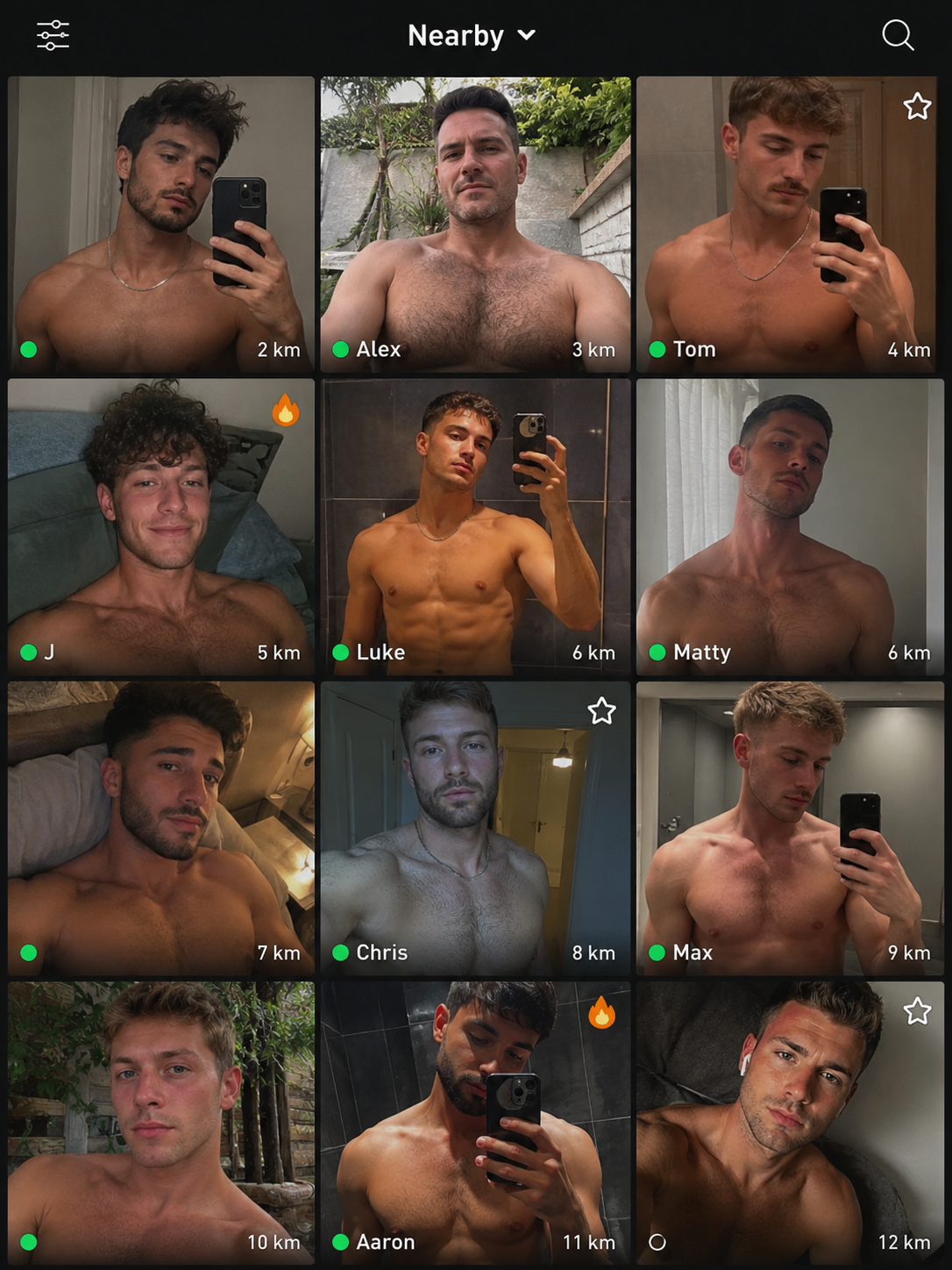
In March 2009, an Israeli-American entrepreneur named Joel Simkhai launched an iPhone app that did one thing Gaydar's desktop world never could. It knew where you were. Grindr took the GPS chip in the new smartphones and turned it into the grid, a mosaic of torsos arranged by proximity, the nearest man first. Three hundred feet away. Nine hundred feet away. The distances were the point. Gaydar had told you that other gay men existed; Grindr told you they were on your street, on your train, in your office building, and it told you this constantly, in real time, wherever you went.
It spread like nothing the community had seen. Within a couple of years it was a global phenomenon and a punchline on panel shows, and within a decade it was simply the default, the app that even people who had never used it could name. It changed the scene's economics, and plenty of ink has been spent, some of it fairly, on what the grid did to gay bars, to cruising grounds, to the serendipity of actually going out. It also changed us in subtler ways, teaching a generation to present themselves in stats and tribes, to negotiate in openers and photo swaps, to experience rejection not as a bad night out but as a constant ambient hum.
And then came the era that tells you everything about what happens when queer infrastructure becomes an asset class. In 2016 a Chinese gaming company, Kunlun Tech, bought a majority stake in Grindr, completing the purchase in 2018. What followed was extraordinary. The Committee on Foreign Investment in the United States, the body that reviews foreign ownership of sensitive American assets, concluded that a database containing the HIV statuses, private messages and precise locations of millions of gay men, some of them closeted, some of them soldiers, some of them in governments hostile to their existence, constituted a national security risk in foreign hands, and it forced Kunlun to sell. Grindr went to an American investor group in 2020 and then floated on the stock market via a SPAC merger in late 2022. The app that began as one man's side project had become, formally and legally, a matter of geopolitics. Our longing, it turned out, was strategically significant data.
Public ownership brought public-company incentives, and ask almost any user what has happened to Grindr since and you will hear the same weary litany, more ads, more paywalls, more features that used to be free now bundled into subscription tiers, an interface that seems designed to interrupt rather than connect. The journalist Cory Doctorow coined a term for this life cycle of platforms, enshittification, and Grindr has become one of the queer internet's most cited examples. This year the company announced its next act, declaring itself an AI-first company and unveiling EDGE, an ultra-premium subscription tier powered by its own AI stack, charmingly branded gAI and pronounced gay-eye, which in trials has been priced at up to 500 dollars a month. Five hundred dollars. A month. For artificial intelligence to summarise your chats, recommend your matches and offer insights into whether the man 900 feet away is worth messaging. The company insists sensitive health data is excluded and the features are optional, and Morgan Stanley has upgraded the stock on the strength of it, which tells you precisely for whom this future is being built.
The counter-revolution
Communities route around damage, and gay men have been routing around Grindr for years. Scruff carved out its territory, Jack'd and Hornet found their audiences, and a hundred smaller apps promised to be the one that finally centred dating over hooking up. But the genuinely interesting insurgency of the past few years has come from the opposite direction entirely, from a platform that did not promise to be nicer than Grindr but promised to be more honest than it.
Sniffies launched in 2018 as a website, not an app, a real-time map of men cruising near you, explicit by design, anonymous if you want it, no App Store rules because there is no App Store, Apple having shown it the door over content restrictions. It is cheerfully, unapologetically what it is, a digital descendant of the cruising ground rather than the lonely hearts column, and it has grown into a platform of roughly three million monthly active users sending north of twenty million messages a day, with merch lines and a podcast and a genuine claim to being a cultural moment. There is something almost poetic in the fact that while the corporate apps spent a decade sanding the sex out of their marketing, the fastest-growing platform in the space succeeded by putting it back in.
Then, in April this year, the money arrived here too. Match Group, the conglomerate behind Tinder, Hinge, OkCupid and more than twenty other dating brands, invested 100 million dollars in Sniffies for a significant minority stake with an option to buy the rest, sunsetting its own underperforming queer app Archer in the process. Sniffies insists it will remain independent and founder-led, that the map will not change, that it is not becoming a traditional dating app. Users, who have watched this film before, immediately began asking about ads, about data, about whether the thing they loved was about to be optimised to death. Grindr's share price dipped on the announcement, which at least confirmed that Wall Street now watches gay cruising platforms the way it watches chip manufacturers.
And running alongside all of this is the quieter migration that rarely makes headlines, the fact that enormous numbers of gay men simply use the mainstream apps now. Hinge, Match Group's designed-to-be-deleted relationship engine, has become the default for a certain kind of gay man in his thirties who wants a second date rather than a location pin. Tinder has always had us. The ghettoisation of gay dating into gay-only platforms, which was once a necessity, has become merely one option among several, and that is its own kind of progress, the freedom to be boring, to meet a husband the same way your straight colleagues met theirs, with prompts about your ideal Sunday and a photo of you holding somebody's dog. There is an argument, made every June by someone on a panel, that this mainstreaming has cost us something, that the specifically gay spaces are thinning out online just as the bars did on land. Both things can be true.
What Goose actually reveals
Which brings us back to the geese. Because Goose's launch, whatever the truth of the AI allegations, is best understood as a product of everything above. It exists because Grindr's decline into an ad-choked subscription machine created a genuine, aching market gap, a generation of gay men who are exhausted by the grid, who tell YouGov and each other that they want connection and community and something that feels less like a meat marketplace. Every word of Goose's marketing, the waves instead of matches, the anti-algorithm positioning, the curated membership in the style of Raya, is aimed with laser precision at that exhaustion. The pitch is not wrong. That is what makes the alleged execution so grim.
Because if the Wired investigation is accurate, the company that diagnosed loneliness as the problem chose synthetic desire as the cure, manufacturing exactly the counterfeit intimacy it claimed to be rescuing us from, and doing it to gay men specifically, a community whose entire digital history has been shaped by the question of who can be trusted with our real names, our real faces, our real locations. The Grindr-Kunlun affair established that our data is a matter of national security. The Goose affair, in its small, farcical way, suggests our attention is now worth fabricating people for. And the terms and conditions row, whatever its legal merits, lands on a community that remembers every breach, every outing, every time a platform built on our intimacy treated that intimacy as inventory.
There is also something bleakly funny about the timing. In the same six months, Grindr has asked us to pay up to 500 dollars a month for an AI to help us flirt, and Goose has been accused of deploying AI to flirt with us for free, as bait. Somewhere between those two propositions is the actual future of gay dating, and neither version of it asked what we wanted. The machines are entering the space between men, from both directions at once, and the one resource they cannot generate, the thing Gaydar had in 1999 and Grindr had in 2009 and Sniffies, for now, still has, is trust.
Twenty-seven years separate Gaydar's launch from Goose's. In that time gay men have moved from coded adverts and premium-rate phone lines to a world where our dating platforms are traded on stock exchanges, reviewed by national security committees and, allegedly, populated by men who do not exist. The technology has been astonishing. The pattern underneath it has barely changed at all. Somebody builds a place where we can find each other. We fill it with our faces, our locations, our wants, the most radioactive information many of us possess. It becomes valuable precisely because we trusted it. And then the question arrives, as it always does, of what the owners intend to do with what we gave them.
Ryan, 21, headphones, looking up at the camera, may never have existed. But the men he messaged did, and they joined the app, and their photos and waves and disappearing pictures are on Goose's servers now, governed by a licence most of them never read. That, in the end, is the oldest story on the gay internet. The boys on the screen come and go. The data is forever.
Sources and further reading: Wired's investigation into Goose's alleged AI promotion network; reporting by Attitude, PinkNews, The Advocate and Out on the app's launch, terms and conditions and the company's response; Match Group's announcement of its 100 million dollar investment in Sniffies (April 2026); Grindr's EDGE and gAI announcements (February 2026) and subsequent coverage by PinkNews, Attitude and Them.