Half the Ward Was Irish: Mammy’s House and the AIDS History We Nearly Lost
A statistic stopped Derek Murphy in his tracks: on some London AIDS wards, he was told, half the patients were Irish. His new play opens a much bigger story — of queer exile, lesbian care, institutional cruelty and the chosen families that refused to let people face the crisis alone.
In the first weeks of lockdown in 2020, Derek Murphy clicked into an online talk that would change the direction of his life.
The speaker was historian and activist Dr Joseph Healy. The subject was LGBTQ+ Irish migrants during the AIDS crisis — a history Murphy, an Irish actor and presenter who had already spent years working in television and theatre, realised he had never been told.
Then came the detail that stopped him cold. According to the research Healy presented, Murphy recalls, some AIDS wards in 1980s London had patient populations that were as much as 50 per cent Irish.
“I had never heard of the AIDS crisis from an Irish point of view before,” Murphy tells OUTCAST WORLD. “The information they were giving absolutely blew me away.”
The statistic is shocking. The silence around it may be even more revealing.
Queer people were leaving an Ireland where male homosexuality remained criminalised until 1993. Many crossed the Irish Sea looking for freedom, safety, healthcare and the chance to live truthfully. In London, some found all of those things. They also arrived just as HIV and AIDS began devastating the communities in which they were trying to build new lives.
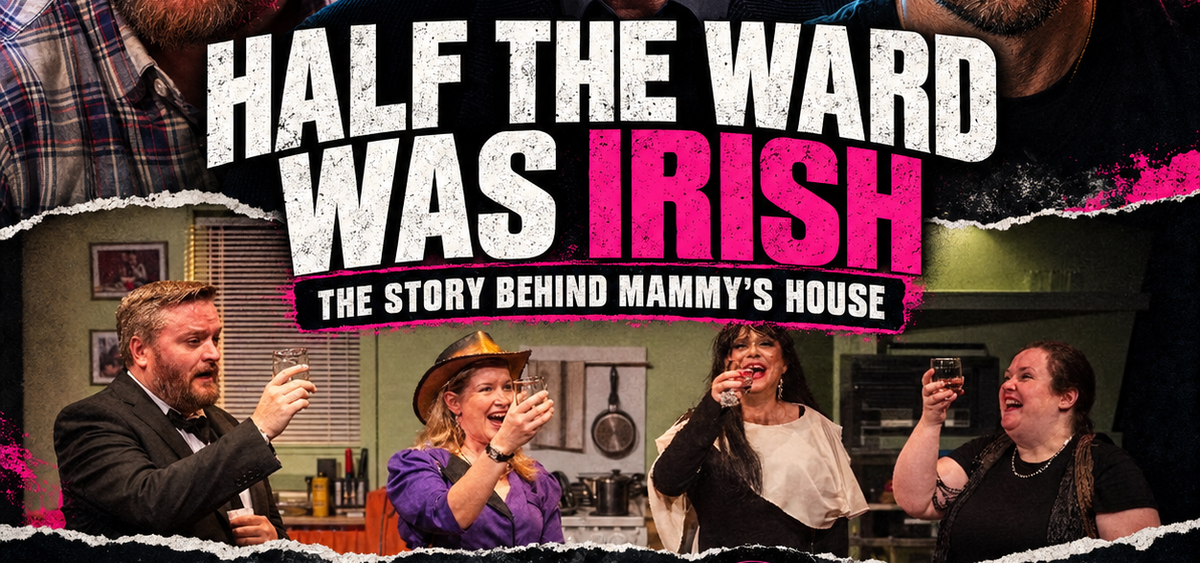
That collision — liberation shadowed by catastrophe — became the foundation of Mammy’s House, the new play created and produced by Murphy, written by his childhood friend Amy Clarke and directed by Brian Brady.
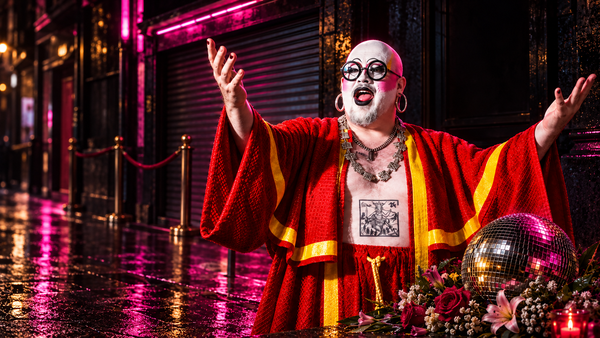
Set in Camden in 1985, the play takes place inside an ordinary London terrace that has become an extraordinary refuge. Its queer Irish residents bicker, laugh, perform, fall in love and care for one another as the AIDS crisis closes in. Murphy plays Barry, known to everyone as “Mammy”: a reluctant guardian presiding over a household of people who have learned that family can be something you create.
The people missing from the familiar AIDS story
Murphy’s discovery was not simply that this history was under-discussed. It was that queer Irish people were often missing even from the culture that had helped a new generation understand the epidemic.
He points to Russell T Davies’s It’s a Sin, rightly celebrated for the lives it placed at the centre of British television. Yet one response to the series stayed with him: given the size of London’s Irish queer population, the absence of Irish characters felt historically conspicuous.
“If nobody’s telling this story, we will,” Murphy decided.
That sentence could sound simple, even triumphant. The process that followed was neither. Murphy and Clarke spent years listening to people who had lived through the period, assembling fictional characters from fragments of real testimony rather than turning any single survivor into a dramatic device.
For Murphy, that created a different kind of pressure from an ordinary acting role.
“There’s a very, very strong feeling of responsibility,” he says. “Because we’re telling a story that really hasn’t been told before, we want to tell it right. We want to do them justice.”
The play also widens the frame beyond gay men. Clarke was determined that Mammy’s House should acknowledge the work of lesbians during the crisis: women who nursed, organised, donated blood, offered friendship and stepped into caring roles when institutions and families disappeared.
Murphy describes what the lesbian community did for gay men as “a debt that can never be repaid”. That idea is not a historical footnote in the play. It is part of its emotional architecture.
“We couldn’t find a church to hold a funeral”
One of the first people Healy introduced to the creators was Bernárd Lynch, the Irish-born activist and priest whose life has been bound up with the AIDS crisis since its earliest years.
In New York, Lynch ministered to a community being ravaged by a disease that was still poorly understood and aggressively moralised. He spoke publicly for safer sex and gay rights. Lynch says he lost his Church employment in 1985 as a consequence.
The cruelty was not abstract. It entered hospital rooms, funeral homes and the language used about the dead.
“We couldn’t find a church to hold a funeral in New York,” Lynch recalls. Many early services took place at a funeral home on West 14th Street. In London, he says, funerals were held at London Lighthouse.
Years ago, in the Channel 4 documentary AIDS: The Priest’s Testament, Lynch issued a warning: “The Church will be judged by AIDS.” He has seen little reason to soften that verdict.
“Religion has very little to be proud of when it comes to HIV and AIDS,” he says. The institutional message received by sick and dying gay men was, in effect, that they deserved what was happening to them. “Imagine saying that to people who are dying.”
Lynch’s answer was not theology delivered from a safe distance. It was care in its most physical and unglamorous form.
“I spent more time changing diapers and wiping up crap from young fellows’ bottoms than I did anointing them or blessing them,” he says.
That image offers one of the most important new ways to understand the era. The response to AIDS was not only made in marches, courtrooms or television interviews, vital though they were. It was also made through intimate acts of care: washing bodies, holding hands, arranging funerals and staying in rooms other people were frightened to enter.
From New York’s corridors to dignity in London
By the early 1990s Lynch was exhausted. But he could not walk away.
He moved to London to work with CARA — Care and Resources for People with AIDS — in pastoral care connected to London Lighthouse. What he found in Britain surprised him.
In New York, Lynch had witnessed people dying in corridors in one of the richest cities in the world. At the Middlesex Hospital in London, people were still dying, but he saw them treated with dignity.
“The Middlesex Hospital was like a walk into paradise,” he says. “They were dying with dignity and human respect. Thank you, NHS. Thank you, UK.”
It is a striking comparison, and an angle often lost when the AIDS crisis is remembered only as a single international tragedy. The virus did not discriminate, as Lynch stresses, but institutions certainly did. Geography, public healthcare, immigration status, religious power and the prejudices of individual families could all determine whether a person faced illness with support or abandonment.
The Irish people Lynch encountered in London were men and women who had often arrived in desperation. Their nationality was not necessarily recorded as the defining feature of their experience. Over time, that made them easier to lose from the story.
A survivor watches his life become theatre
Lynch has now seen Mammy’s House twice.
The first visit was painful. The second was easier, but not easy. He describes the play as black comedy and as one of the most “profound and authentic” expressions of an era he has spent his life carrying.
“I had to go and see it twice out of respect for Derek and the desire to help in every way I could,” he says. Meeting the actors afterwards moved him to tears.
What affected him was not a flawless reconstruction of specific individuals. The characters are composites. What the production captures is a moral truth about the period: when official sources of love and protection failed, queer people put love into the space themselves.
Lynch repeats the same phrase twice, as though it is both instruction and benediction: “Where there is no love, put in love, and there you will find love.”
That is the real house in Mammy’s House. Not the Camden bricks, the wigs or the burnt toast, but the improvised structure of care built by people who had been rejected elsewhere.
Who gets called a giant?
There is a revealing disagreement between Murphy and Lynch, although it is an affectionate one.
Murphy tells Lynch that his generation is “standing on the shoulders of giants”. The freedoms visible at a modern Pride march — partners walking together, friends covered in glitter, music playing openly in the streets — did not arrive by accident.
“Those rights were not just handed to us,” Murphy says. “They were fought for. There was blood, sweat and tears poured into that.”
Lynch pushes the praise back toward the younger artists. He says he did not think of himself as a giant; he became involved because “my brothers were dying”. To him, the giants now include Murphy, Clarke and the performers carrying these experiences to audiences who never lived through them.
The exchange reveals why Mammy’s House matters. Memory does not pass automatically from one generation to another. Someone must ask the questions. Someone must trust them with the answer. Someone must then find a form capable of making strangers listen.
Theatre cannot restore the people who died, nor can it repay every act of courage and care. What it can do is refuse the second disappearance: the moment when a life vanishes from public memory as well as from the world.
“A lot of these people are not here to tell the story themselves,” Murphy says. “They don’t deserve to be forgotten. They deserve to be remembered.”
Mammy’s House is therefore more than a period drama. It is an argument about who belongs in queer history, who gets erased from national history and what the living owe the dead.
Half the patients on some London AIDS wards may have been Irish. Behind that startling number were individuals who had already crossed a sea to live more authentic lives. In London they created homes, friendships and chosen families — and, when the crisis came, systems of love strong enough to do what governments, churches and biological relatives sometimes would not.
That is the history Mammy’s House brings out from behind a closed door and places, finally, under the stage lights.
Mammy’s House runs at Upstairs at the Gatehouse, Highgate until 13 September 2026. It is written by Amy Clarke, created and produced by Derek Murphy, and directed by Brian Brady.