Heartstopper Forever, Sex, and the Right of Queer Characters to Become Adults
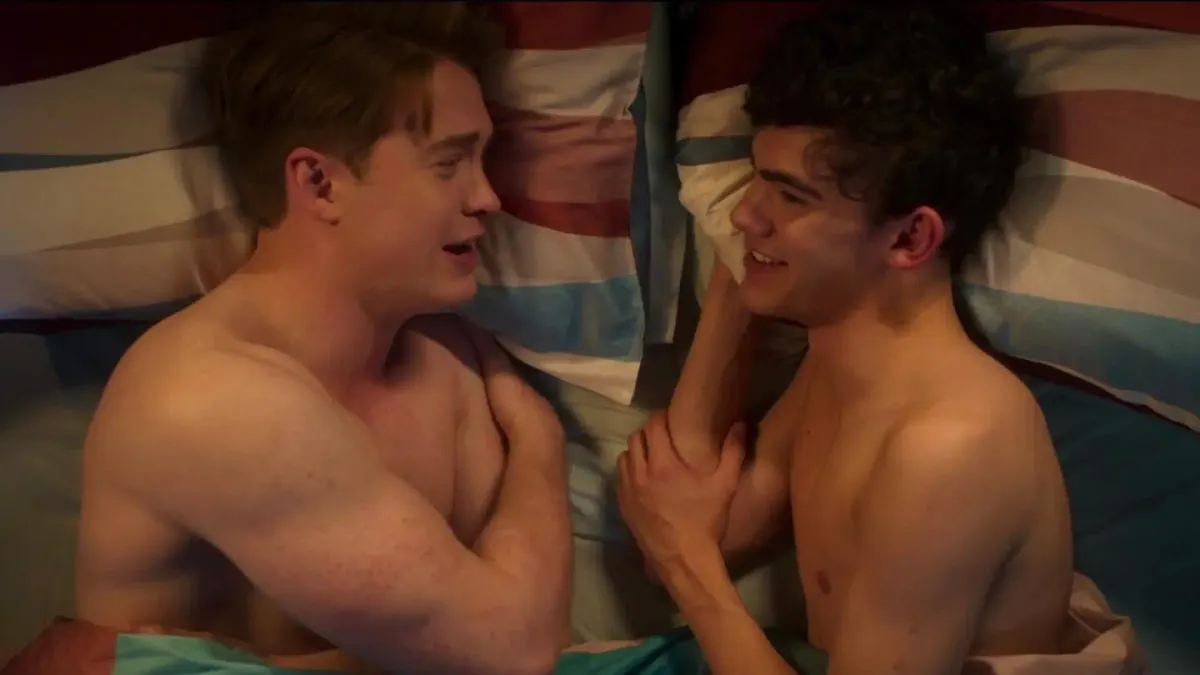
When Heartstopper arrived on Netflix in the spring of 2022, it was greeted as something close to a miracle, and in a sense it was one. Here was a queer teen romance with no dead boyfriend, no predatory older man, no third-act tragedy waiting in the wings to punish two boys for the crime of holding hands; just Nick Nelson and Charlie Spring, a rugby lad and the boy who sat next to him in form, falling in love in a haze of animated leaves. For a generation of young queer viewers it was the first time the screen had told them their feelings might end well, and for a rather older generation it was something stranger and sadder: a glimpse of the adolescence they were never permitted to have.
Four years on, the story ends. Heartstopper Forever, the feature-length finale written by Alice Oseman and directed by Wash Westmoreland, lands on Netflix this Friday, following Nick and Charlie to the edge of university and the looming question of long-distance love, with Kit Connor and Joe Locke stepping up as executive producers for the first time. And ahead of release, the pair have confirmed what the trailer strongly implied and what a certain corner of the internet has been bracing for: this time, the boys have sex, and the film is not going to be coy about it.
Connor, speaking to the Guardian, framed it as a question of honesty rather than provocation, acknowledging the line the production had to walk while pointing out the obvious, which is that two young men this attracted to each other, at this age, would plainly be sleeping together, and that pretending otherwise would be the artificial choice. Locke put it more bluntly, noting that the film contains considerably more sex than the series ever did and that "it would be weird if we hadn't shown it". He was careful, too, about what the show is not saying: Nick and Charlie remain monogamous, but Heartstopper, in his telling, has never had anything bad to say about casual sex, and an earnest register is not the same thing as a chaste one. The pair even managed some gallows humour about the mechanics of filming intimacy for a major streamer, all silent rooms, hovering crews and the small indignities of a cock sock, which is about as unglamorous a description of screen romance as you will ever read, and rather charming for it.
The wholesomeness trap
It would be easy to file this under promotional chatter and move on, but there is something genuinely worth sitting with here, because Heartstopper has spent four years at the centre of one of the queer community's oldest and most uncomfortable arguments, usually without asking to be.
From the moment it premiered, the show was praised, relentlessly, for being wholesome. Wholesome was the word in every headline, every tweet, every earnest video essay, and on the surface it was a compliment. But wholesome is a word with teeth. Praise a queer love story for its purity often enough and the praise curdles into a standard, and the standard becomes a stick, and before long the show was being wielded online as the acceptable face of queerness against which everything else could be measured and found wanting: too sexual, too messy, too adult, too much. A story created to tell young queer people they were lovable was being repurposed, by some of its loudest fans and plenty of bad-faith observers besides, to tell adult queer people they were embarrassing.
That trap has a long history, and our community knows its shape intimately. Queer people have always been offered visibility on the condition of desexualisation; the sitcom neighbour, the wise best friend, the couple who may be mentioned but never seen to touch. The deal is that you may exist on screen so long as nobody is reminded of what your existence actually involves, and generations of writers accepted those terms because the alternative was invisibility. What makes the discourse around Heartstopper so strange is that this time the pressure to stay chaste came not only from the usual quarters but from inside the fandom, from viewers who had grown so protective of the show's innocence that any hint of its characters ageing into desire was treated as a betrayal.
Which is why Locke's framing matters more than it might first appear. In refusing to accept that earnestness and sex are opposites, he is dismantling the trap rather than negotiating with it. The radical proposition of Heartstopper was never that queer love is pure; it was that queer love is ordinary, entitled to the full and unremarkable arc that straight stories have always taken for granted, and the full arc includes the bit where two eighteen-year-olds who adore each other close the bedroom door. A show that froze its characters at the hand-holding stage forever would not be protecting them. It would be embalming them.
Not suitable for children, and other lies
There is a wider context to all this, and it is not a pleasant one. This publication has spent the past fortnight covering a broadcaster's cheerful willingness to platform the claim that queer visibility is inherently sexual and therefore inherently dangerous to children, a slur as old as the community itself, currently enjoying one of its periodic revivals. The argument is unfalsifiable by design: when queer stories include sex, that is the proof; when they do not, the sex is merely hidden, lurking, implied. Chastity buys no safety from people arguing in bad faith, because the objection was never really about sex. It was about existence.
Seen against that backdrop, the decision to let Nick and Charlie grow up honestly is quietly defiant. Heartstopper played by every rule of respectability for three seasons, was showered with praise for doing so, and watched the same old accusations roll on regardless. Its answer, in its final chapter, is not to court controversy but simply to decline the bargain: to depict two boys in love doing what people in love do, tenderly and matter-of-factly, and to trust its audience, which has aged four years alongside its characters, to receive that as the natural end of the story rather than a scandal. Locke's simplest line is also his best one, the observation that there is nothing complicated here, just the pleasure of watching two boys in love. Everything else is other people's baggage.
There is a lovely irony in the director's chair, too. Wash Westmoreland's route to this film ran through Still Alice and Colette, prestige cinema of the most respectable kind, but his earliest work was in gay adult film, a corner of the culture that respectable representation has spent decades pretending not to know. That the man now shepherding the most beloved queer teen romance of its era across the threshold into adulthood carries that history feels less like coincidence than quiet poetic justice; the two supposedly irreconcilable traditions of queer storytelling, the tender and the carnal, turning out to have been the same tradition all along.
Kit Connor knows better than most what happens when an audience decides it owns a queer story's terms; he was, lest anyone forget, effectively forced to declare his own sexuality at eighteen by fans who had appointed themselves the show's morality police. That he and Locke now hold producer credits on the finale, steering the characters they grew up inside towards an honest adulthood, is its own small act of reclamation. The boys are grown, in every sense. The show has grown with them. And if that makes anyone uncomfortable, it is worth asking, gently, why the discomfort only ever seems to arrive when the boys in love are boys.
Heartstopper Forever streams on Netflix from 17 July.