Saudi Arabia, the 2034 World Cup, and the Art of Renting Out Tolerance
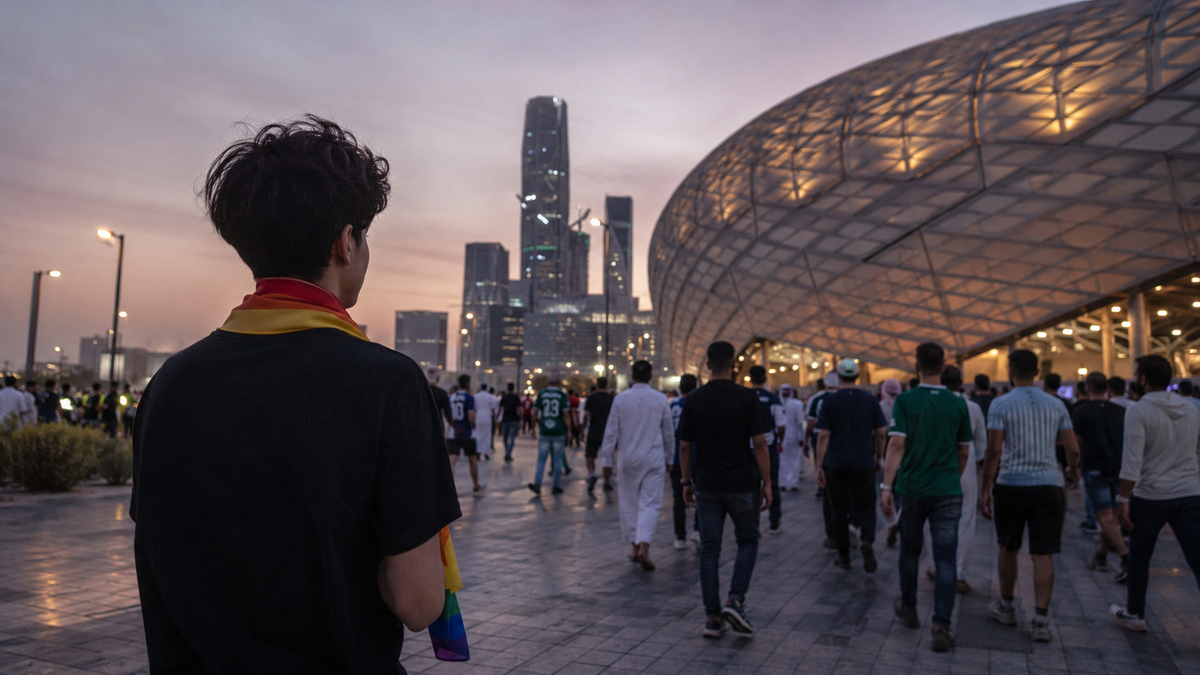
Saudi Arabia would like LGBTQ+ football fans to know that they will be welcome at the 2034 World Cup. It would also like them to know, though it phrases this part rather more quietly, that homosexuality remains a criminal offence in the kingdom, punishable in certain circumstances by death, and that publicly supporting LGBTQ+ rights can land a person in prison. Both of these things are being said at once, by the same state, about the same tournament, and the fact that nobody involved seems embarrassed by the contradiction tells you almost everything about how international football now works.
The charm offensive is well under way. This week brought news that the kingdom is actively reassuring queer visitors ahead of the tournament, part of a years-long softening of the national image under Crown Prince Mohammed bin Salman that has already delivered women behind the wheel, reopened cinemas and a tourist visa regime designed to bring non-Muslim money into the country. There is even, remarkably, an LGBTQ+ cruise on the books: the American travel company VACAYA has announced an Arabian Nights sailing for spring 2027, departing from Jeddah and heading for Egypt, marketed on the premise that a quiet but notable shift is under way in a country queer travellers once could not imagine entering at all. A gay cruise leaving a Saudi port is, on its face, an extraordinary sentence to be able to write. The question is what it actually means, and the answer is rather less extraordinary than the brochure suggests.
The two kingdoms
The most useful description of what is happening comes not from FIFA, nor from the tournament's organisers, but from a Saudi lawyer and activist named Tariq Aziz, who says he was detained by the authorities in 2021 and 2022 for promoting homosexuality before eventually being granted refugee status in the United States. There are, he says, two Saudi Arabias: <cite index="12-1">"one meant for foreigners, more tolerant and more open, and another meant for citizens"</cite>.
Hold that sentence up to the light, because it is the entire business model. The kingdom is not liberalising; it is partitioning. Tolerance is being manufactured as an export product, available in designated zones for holders of foreign passports, while the domestic legal architecture, the morality policing, the prison sentences and the executioner's sword remain exactly where they were. Observers of the country note that the authorities will generally turn a blind eye to same-sex relationships provided they remain private, which sounds like progress until you say it slowly. Tolerance conditional on invisibility is not tolerance. It is the same bargain queer people have been offered by every hostile power in history, from the family dinner table to the state: exist if you must, but do not be seen to.
And that bargain, crucially, is only on offer to visitors. The gay fan flying in from Manchester for the group stages gets the foreigners' kingdom, the smiling one, the one with the hospitality training and the carefully briefed stewards. The gay Saudi who serves him his coffee gets the other one, and will still be living in it long after the caravan has moved on to the 2038 bidding cycle. Every reassurance issued to international fans is, in this sense, a small act of cruelty towards the kingdom's own queer citizens, because it prices their safety at precisely nothing while spending real money on the comfort of strangers.
How we got here, again
None of this arrived by accident, and none of it should surprise anyone who watched the last decade of international football. The 2018 World Cup went to Russia, where it is illegal to suggest that same-sex relationships are normal. The 2022 tournament went to Qatar, where same-sex activity carries prison time, and where fans were assured, right up until the moment rainbow-coloured items started being confiscated at stadium gates, that everyone would be welcome. In December 2024, FIFA completed the set, confirming Saudi Arabia as the 2034 host after every other potential bid melted away and the kingdom was left as the sole candidate. Human rights organisations responded by accusing the governing body of discarding its own human rights policies, warning that without comprehensive reform the tournament would be delivered on a foundation of repression, discrimination and exploitation. FIFA held the vote anyway.
Since then the reassurance industry has been in full production. Hammad Albalawi, the man who led the Saudi bid, told Sky Sports that LGBTQ+ fans would be respected and welcome, describing the nation as being on a journey of remarkable transformation, while also noting, in a phrase doing an enormous amount of load-bearing work, that the kingdom respects the privacy of all its guests. Privacy, there, is not a courtesy. It is the terms and conditions. You will be welcome in Saudi Arabia in 2034 the way a rainbow flag was welcome in Doha in 2022, which is to say: in theory, at a distance, and provided nobody actually sees it.
The campaigner Peter Tatchell, to his considerable credit, has tried to pin the organisers down on precisely this point, writing to Albalawi to request commitments on the safety of LGBTQ+ visitors, their freedom to express support for queer rights, legal protection from discrimination, non-discrimination in hospitality venues and engagement with human rights groups. These are not radical demands; they are the minimum conditions under which the word welcome means anything at all. It is instructive that, years out from the tournament, they remain requests rather than guarantees, and that Amnesty's guidance for the kingdom still notes that publicly supporting LGBTQ+ rights is itself criminalised. A country cannot simultaneously welcome queer fans and imprison people for saying queer people deserve rights. It can only welcome their money, which is a different transaction, and one the kingdom has become exceptionally good at.
The uses of a rainbow
Which brings us back to that cruise, and to the broader question of what queer visibility is being used for here. Sportswashing is by now a familiar accusation, levelled at the kingdom over everything from the Saudi Pro League's transfer spending to the LIV golf project, and the standard defence is always the same: engagement drives change, the spotlight helps, come and see for yourself. Stonewall itself has framed the tournament as an opportunity to keep challenging Saudi Arabia on human rights long after the final whistle, and there is a serious argument there, made by serious people in good faith.
But the argument only works if the pressure is real and sustained, and the record of the last two tournaments suggests it is neither. The spotlight moved on from Russia. It moved on from Qatar with almost indecent speed, the armbands unworn, the protests folded away, the broadcasters back to talking about the football within days. What the host state gains is permanent: the images, the legitimacy, the memory of a month in which the world came and nothing terrible appeared to happen, because the terrible things had been carefully scheduled around the fixtures. What the visiting queer community gains is a fortnight of conditional courtesy in the foreigners' kingdom. And what the local queer community gains, in every one of these countries, has so far rounded to zero.
An openly gay footballer, Australia's Josh Cavallo, put the human cost of all this plainly when he said there are countries he simply will not travel to for his sport, because they do not approve of how he loves. That a professional at the top of the men's game feels he must route his own career around the World Cup's chosen hosts is not a footnote to this story. It is the story. The tournament that markets itself as the world's game has now, three times in a generation, chosen venues where some of the world is illegal.
So by all means note the reassurances, and note the cruise, and note the remarkable transformation. But keep hold of the distinction the kingdom itself is relying on you to forget. Two Saudi Arabias are being built for 2034. One of them is a set. The other one is where people live, and where being what this publication's readers are can still, on the wrong day, in front of the wrong judge, cost a person everything. Until those two kingdoms become one, welcome is not a promise. It is a price list.