The gay man with the nuclear codes: what Wes Streeting's return says about us, and about him
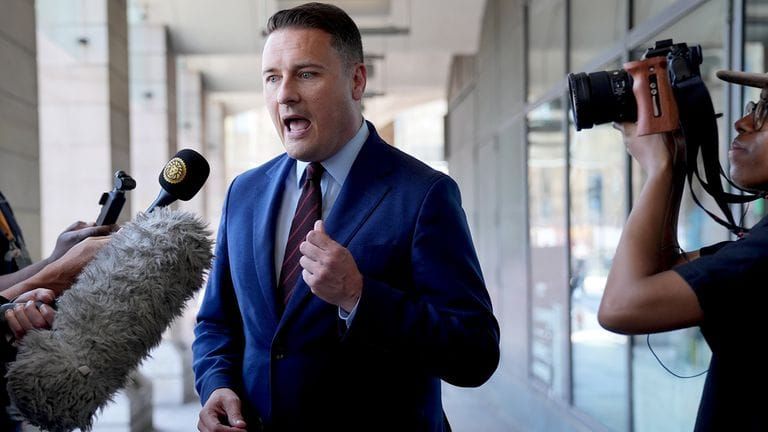
Andy Burnham's first cabinet was always going to be read as a statement of intent, and buried within Monday's procession of familiar faces through the black door was an appointment that deserves more scrutiny than the news cycle will give it. Wes Streeting, who walked out of Keir Starmer's government in May with a resignation letter that read like an indictment, is back. Not at health, where he made his name, but at defence, where he will sit on the National Security Council, oversee the continuous at-sea nuclear deterrent, and take responsibility for the hard machinery of British power.
Let us start with what this means before we get to what it costs. There has never been an openly gay Secretary of State for Defence in this country. Michael Portillo held the office in the mid-nineties and spoke about his past only years after leaving it, which is a different thing entirely, a story about the closet rather than a story about visibility. Streeting arrives at the Ministry of Defence as a man who has been out for his whole political career, and he arrives at a department with a uniquely shameful institutional memory. Until January 2000, it was illegal to be openly gay in the British armed forces. People were interrogated, dismissed, stripped of medals and pensions, in some cases imprisoned, for the crime of loving the wrong person while wearing the uniform. It took a European Court of Human Rights ruling to force the change, and it took until 2023 for a Prime Minister, Rishi Sunak of all people, to stand at the despatch box and apologise for what the state had done. The Americans got there first on representation, swearing in Eric Fanning as the first openly gay Army Secretary a decade ago, but a gay man in overall command of the Ministry of Defence is a genuine first for Britain. Within living memory, this department hounded people like him out of the services. Now one of them runs it. That is not nothing, and we should not pretend it is.
But Outcast World is not in the business of pretending, and so we also have to say the other thing. Streeting's record on trans healthcare is a wound this community carries, and no amount of symbolism at the MoD closes it. As health secretary he took the Cass Review and ran with it, imposing a ban on puberty blockers for under-18s in 2024 and making it permanent, and after the PATHWAYS trial was suspended following its 2025 launch, NHS England under his tenure stopped issuing new prescriptions for gender-affirming hormones to 16 and 17 year olds. Ten LGBTQ+ youth organisations wrote to him before his resignation begging him to reverse course and, in their words, to start listening to the trans young people his decisions affect. He did not. Campaigners and grieving families have linked those restrictions to the deaths of young people denied care, a claim the government has always contested, and whichever way that dispute is ever settled, the despair underneath it is not in dispute at all. Trans young people and their parents have spent two years describing a healthcare system that slammed shut around them, and the man who held the door gets a promotion.
So which was it? Was Streeting simply an instrument of Starmerism, a loyal secretary of state enacting a settlement decided above his head, in an administration that treated trans people as an acceptable sacrifice in a culture war it had convinced itself it needed to fight? Or did he believe it? The honest answer is that the evidence does not let him off. There was no reluctance in his language, no daylight between him and the policy, no signal of the kind ministers routinely send when they are implementing something through gritted teeth. He cited Cass with conviction and defended the restrictions as child protection. His resignation letter in May, which attacked Starmer for presiding over drift and warned that nationalism posed an existential threat to the United Kingdom, was full of moral urgency about racism and the future of progressive politics. Trans people did not feature. Whatever Starmerism demanded of him, the omissions were his own. And either version is grim: a true believer is grim, and a man who administered that much harm to a vulnerable community out of mere political convenience is arguably grimmer.
There is a cold irony in where he lands next. Defence is a brief that runs on exactly the kind of arithmetic he now stands accused of, the weighing of harm against objective, the acceptance of casualties in service of a larger strategy. Streeting has spent his months on the backbenches positioning himself as a hawk, backing war bonds to fund rearmament and calling for outdated programmes to be scrapped, and he will now be tasked with increasing the lethality of Britain's armed forces at the most dangerous moment for European security in a generation. He may well be good at it. The uncomfortable truth about Streeting, the thing his critics in this community have to hold alongside their anger, is that he delivers. He left the Department of Health with waiting lists falling by 110,000 in a single month, the biggest drop outside the pandemic since 2008, with two thousand more GPs recruited, ambulance response times for heart attacks and strokes at their fastest in five years, and a service that was on its knees under the Conservatives showing measurable, sustained recovery. It is one of the very few unambiguous delivery stories this Labour government has produced. He achieved it while treating trans people as collateral damage, and both of those sentences are true at once.
The question now passes to others. Yvette Cooper inherits health and with it the pressure, already building, to reverse what Streeting put in place. Burnham arrives in Downing Street with a long record of LGBTQ+ allyship and a promise to be a circuit-breaker for the country. Whether that circuit includes the trans people his new defence secretary left behind will tell us whether anything has actually changed, or whether the faces have simply been reshuffled. History was made on Monday. For some of us, it was made by a man we cannot yet forgive.