


US Officials Remove Pride Flag from Stonewall — and Call It “Consistency”
THEY TOOK THE FLAG DOWN"
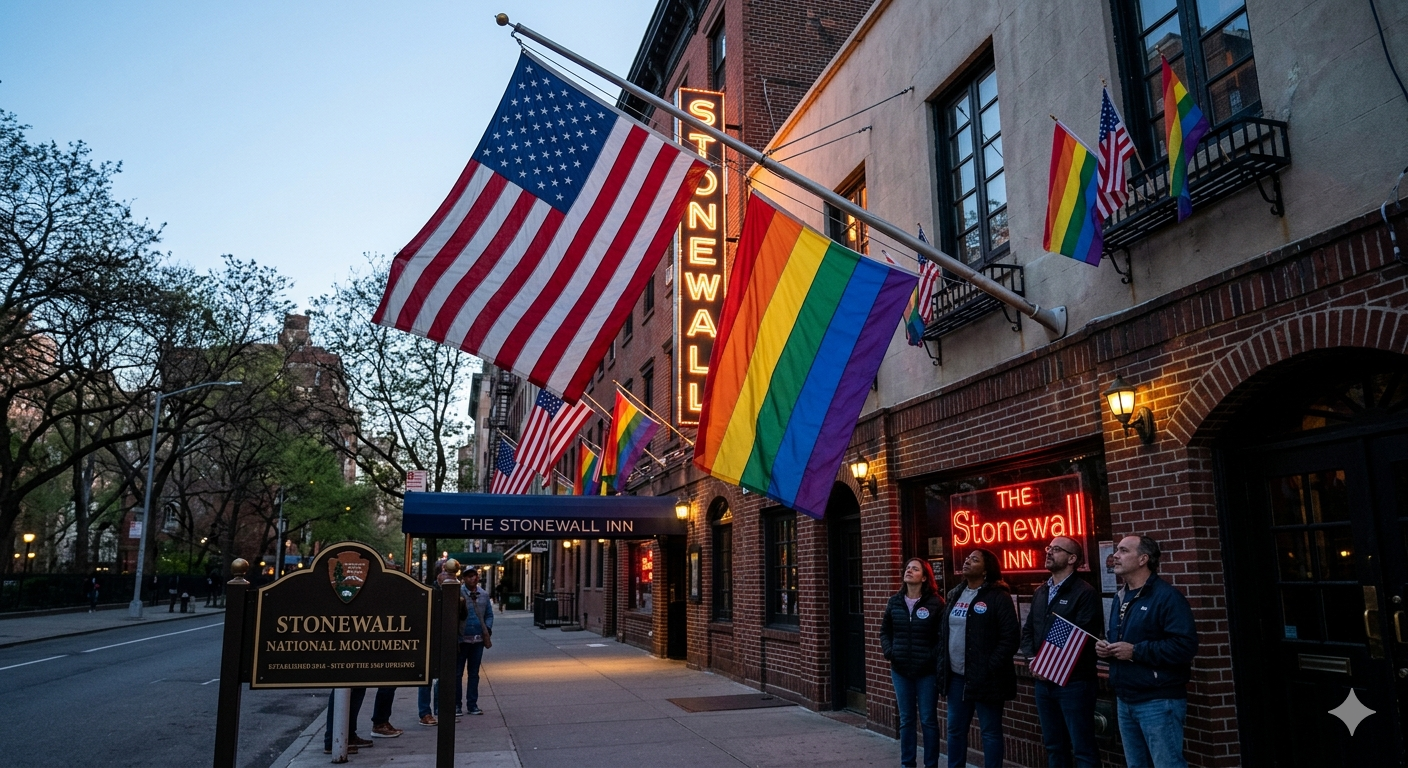
On a quiet evening in early February, someone from the National Park Service climbed a set of steps in Manhattan's Greenwich Village and took down a Pride flag. No announcement. No fanfare. Just a bare flagpole where a rainbow had been, steps from the Stonewall Inn — the birthplace of the modern LGBTQ+ rights movement.
The flag had flown at the Stonewall National Monument since 2019. It was placed there as a federal acknowledgment: this happened, these people mattered, this history is ours. Its removal came under a directive restricting what flags could be displayed on National Park Service sites — only the US flag and departmentally authorised banners allowed. The Interior Department called it a consistency measure. Everyone else called it what it was.
New York erupted. Within 48 hours, hundreds gathered at the monument. Protesters draped rainbow flags over their shoulders. Chants echoed between the park's statues. The city's mayor said he was "outraged." The Manhattan Borough President — the first openly gay person to hold that office — announced he'd reinstall the flag himself. And days later, he did, raising a new rainbow banner alongside the Stars and Stripes while the crowd roared.
But even that act of defiance split opinion. Some activists pointed out that the replacement was the traditional six-stripe rainbow flag, not the Progress Pride flag that includes trans and intersex representation. One trans woman at the rally called it "a half measure." A trans playwright said it felt "extremely performative." The community was fighting the government and debating itself at the same time — which, if you know queer politics, sounds about right.
Lambda Legal filed a lawsuit against the National Park Service, the Department of the Interior, and Interior Secretary Doug Burgum. The Gilbert Baker Foundation — named after the late artist who created the original Pride flag — joined as plaintiff. Their argument was straightforward: the flag's removal was targeted, not procedural. They pointed out that Confederate battle flags remain displayed at other National Park sites under a "historical context" exemption. If a Confederate flag qualifies as historical context, how does a Pride flag at Stonewall not?
This wasn't an isolated incident. A year earlier, the NPS had already scrubbed references to transgender and queer people from the Stonewall monument's website, replacing "LGBTQ" with "LGB" in places. Transgender flags had been quietly removed. The web page that once told the full story of 1969 — including the trans women of colour who were central to the uprising — had been edited down.
Senators introduced legislation to permanently authorise the Pride flag's display at the monument. Whether it passes is another story entirely.
What does a flag actually mean? On its own, it's fabric and dye. But at Stonewall, it's a marker that says the federal government sees you. Removing it says the opposite. And in 2026, when queer history is being actively rewritten at the institutional level — not by accident, but by policy — the fight over a flagpole isn't symbolic. It's the whole war in miniature.