A ban worth having, from a government that spent two years dismantling the rest
Labour has finally published its draft bill to ban conversion practices, eight years after a Conservative prime minister first promised one. It is the right thing to do, and it arrives from a government that has spent its time in office entrenching almost every Tory position on trans people it inherited rather than reversing a single one.
Outcast World editorial
There is a particular kind of political theatre in which a government takes a bow for clearing a bar it set so low, so long ago, that the applause curdles before it reaches the back of the room. The publication this morning of the draft Conversion Practices Bill, which would make it illegal across England and Wales to attempt to change a person's sexual orientation or gender identity, belongs squarely to that genre. It is a genuinely good piece of legislation in principle, the product of years of patient, exhausting campaigning by survivors, faith groups and human rights organisations, and it deserves to become law without the loopholes that have hollowed out every previous draft. It is also, unavoidably, being delivered by the same government whose first eighteen months in power have coincided with the steepest collapse in this country's standing on LGBTQ+ rights in a generation, and that contradiction is not a footnote to the story. It is the story.
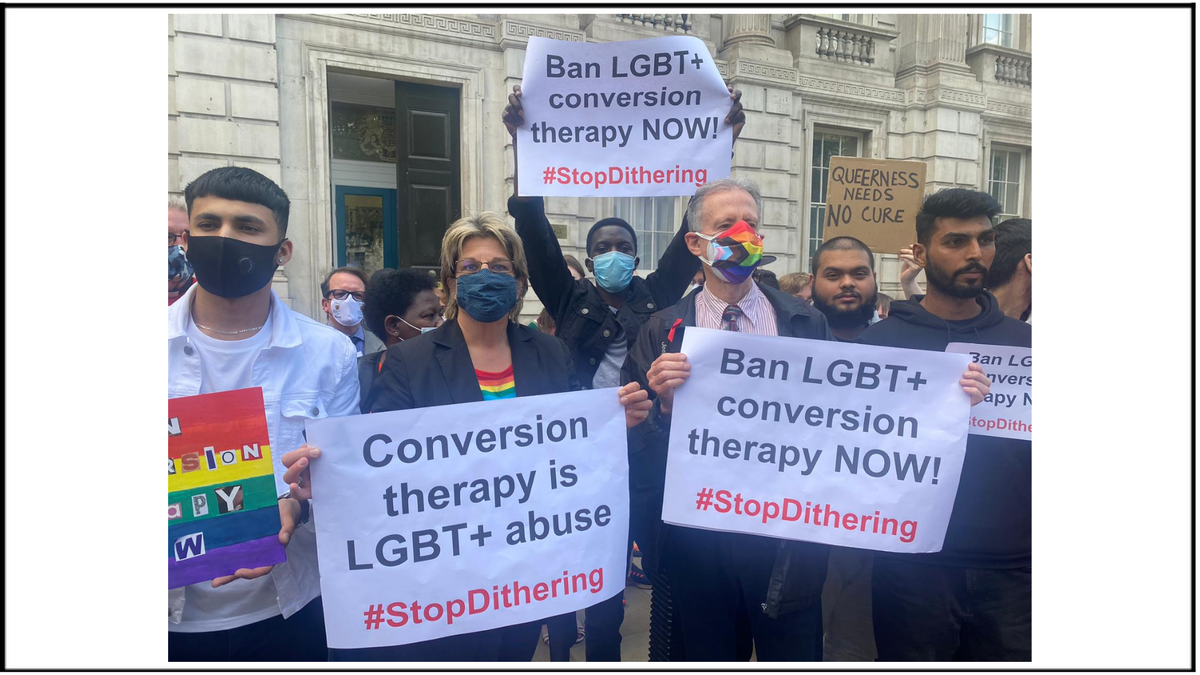
Let us begin with what the bill says, because it matters and because the campaigners who fought for it have earned a fair hearing before the wider argument is made. The legislation, published for pre-legislative scrutiny rather than introduced as a finished article, would for the first time criminalise attempts to suppress or alter someone's identity through the coercive counselling, forced prayer, so-called exorcisms and pseudo-psychological pressure that survivors have described for decades. Crucially, and this is the line on which the entire credibility of the exercise rests, it covers gender identity as well as sexual orientation. Stonewall's chief executive Simon Blake welcomed it as an "historic and long overdue step forward", and said the charity would comb the detail for any gap that might let the practice continue under another name. He framed the bill as telling LGBTQ+ people, in effect, that they do not have to change who they are, which is the kind of sentence that ought to be unremarkable in 2026 and somehow still is not.
Saba Ali, who chairs the Ban Conversion Practices Coalition, called it a special day after years of campaigning, delay and what she bluntly described as broken promises from one government after another, and she located the significance precisely where it belongs. "A ban that leaves trans people out is not a ban at all," she said, welcoming the inclusion of protection on grounds of gender identity as well as sexuality. That single sentence carries more weight than its plain wording suggests, because the entire ugly history of this legislation has been a sequence of governments looking for ways to drop the word "trans" from the text and call the remainder a victory. The survivor identified only as Ian, who told reporters the experience had wrecked his confidence and left a lasting mark on his mental health, described the announcement as feeling like a moment of justice, and there is no honest way to write about this bill that does not begin by taking him at his word.
Humanists UK, which has pressed the case at the United Nations and tracked the money flowing through the organisations that still run these programmes, welcomed the draft as the start of a process while warning, in the careful language of people who have been disappointed before, that religious freedom cannot be allowed to function as a shield for abuse. The organisation has pointed to investigative work suggesting the income of several Christian charities promoting conversion practices surged dramatically across recent years, which is a useful corrective to anyone tempted to treat this as a historical problem rather than a live and growing one. So the bill is necessary, the demand for it is evidenced, and the people who built the case for it have every right to mark the day. None of that is in dispute here.
What is in dispute is the story the government would like you to take from it, which is a story of a progressive administration delivering for a community the Conservatives abandoned. That story does not survive contact with the record.
The promise that took eight years to become a draft
Start with the timeline, because it is its own indictment. The commitment to ban conversion therapy was first made in 2018, under Theresa May, as part of an LGBT Action Plan that was meant to mark a high-water mark of Conservative engagement with queer rights. What followed was not legislation but a slow, demoralising relay of abandoned consultations, leaked U-turns and ministers discovering, every time the moment arrived, some fresh reason to wait. By the spring of 2025 Stonewall was publicly accusing the current government of missing its own deadline to publish a draft, with Blake noting that conversion practices are abuse and that LGBTQ+ people do not need fixing, only the basic assurance that the state would protect their safety and dignity rather than at some unspecified future date. The bill that has appeared this week, then, is not an act of leadership so much as the eventual discharge of a debt that three prime ministers ran up before the present one inherited it. A government that wished to be judged generously on this would have moved in its first months. It moved in its second year, after public pressure, and only as a draft.
What Labour did with the trans policy it inherited
Here is the part the celebratory coverage tends to skirt. When Labour took office it did not arrive to a blank slate on trans rights; it arrived to a set of Conservative policies, many of them recent and contested, and at almost every juncture it chose to keep them, formalise them, or defend them in terms more or less indistinguishable from those of the people who introduced them.
The clearest example is the ban on puberty blockers for under-eighteens. The emergency restriction was first imposed by the outgoing Conservative government in 2024 in the wake of the Cass Review. It would have been entirely open to an incoming Labour health secretary to treat that emergency measure as exactly that, a temporary order to be reviewed on the evidence. Instead, in December 2024, Wes Streeting made the ban indefinite, with no review scheduled until 2027 and prescription available only through an NHS trial that, more than a year on, has still not begun. Streeting, who is gay and who has spoken movingly about his own formation during a period of legal discrimination, has not hidden his discomfort. He has called the decision "truly uncomfortable" while insisting it was ultimately right, and told an NHS conference that it had not sat easily with him at all that young people describe to him what the loss of that care has meant. More recently he has been blunter still, saying he believes he did the right thing on the medical advice and stands by it. The trans young people and families on the receiving end of that decision have been considerably less equivocal, and reporting on the ban has documented overwhelming distress among those affected, including self-harm and suicidal thoughts, which is the human cost that sits underneath the language of caution and evidence. Critics within the community have made the obvious point that a health secretary cannot warn about a rollback of LGBTQ+ rights, as Streeting has, while personally maintaining one of its sharpest edges.
Then came the Supreme Court. In April 2025 the court ruled in For Women Scotland that "sex" in the Equality Act 2010 means biological sex, so that a trans woman holding a gender recognition certificate is, for the purposes of that Act, to be treated as male. A government can respond to a court ruling in more than one register. It can accept the law while working to protect the people the ruling exposes, or it can embrace the judgment as welcome clarity and set about implementing its harshest reading. Labour chose the second. The party's own guidance described the decision as providing clarity, the Equality and Human Rights Commission began drafting a code of practice whose thrust is the exclusion of trans people from the single-sex spaces of their gender, and Labour even postponed its national women's conference and launched a review of its own positive action measures to comply. When Labour MP Nadia Whittome stood in the Commons and asked whether the government would reverse its rollback of LGBT rights, including the puberty blocker ban, and unequivocally defend the Equality Act's protections for trans people, the answer she received was the now familiar reassurance that trans people deserve dignity and respect and retain protection from discrimination, which is true as far as it goes and travels nowhere near far enough.
The EHRC's draft guidance has since been described even by Labour for Trans Rights as unworkable and exclusionary, requiring radical change before it could be considered fit for purpose, and the practical consequences have rippled outward into sport and public life, with the Football Association and England Hockey both moving to bar trans women from women's categories in alignment with the ruling. This is not a government that found itself reluctantly bound by a court. It is a government that took the ruling and ran.
The view from outside
If you want a measure of how this looks from beyond Westminster, the international benchmarks are unsparing. ILGA-Europe's 2025 Rainbow Map recorded the United Kingdom suffering one of the three steepest falls on the continent, alongside Hungary and Georgia, dropping to twenty-second of forty-nine countries after the Supreme Court ruling and the government's response to it. A decade ago, in 2015, the UK topped that same table. On the narrower question of legal recognition of trans people's identities the country now sits forty-fifth of forty-nine, keeping company, as ILGA-Europe pointed out, with Bulgaria, Georgia, Hungary and Russia. The European trans rights network TGEU put it with a sharpness that British politicians have largely been spared at home, observing that the UK now has a supreme court, a prime minister and an equality body singing from the same hymn sheet as anti-trans campaigners. To be grouped, on the trajectory of your trans rights record, with the government that banned Pride in Budapest is not the company a self-described progressive administration should be comfortable keeping.
The campaigners at ReportOUT made the essential analytical point that the UK's decline is not the result of equality having gone too far, as the culture war framing would have it, but of progress stalling at home while other countries moved decisively forward. Spain, Malta, Iceland, Belgium and Denmark have shown what political leadership on this looks like when a government actually wants to lead. Britain, on the present evidence, does not, and the conversion practices bill is being asked to carry a reputational weight it cannot bear on its own.
Can a hostile government deliver an inclusive ban?
Which brings us to the question the celebratory coverage will not quite ask. Can a trans-inclusive conversion ban be trusted in the hands of a government that has spent its capital elsewhere defending trans exclusion? The honest answer is that the inclusion is real on the page and fragile in the politics. The drafting matters enormously, because every previous attempt has foundered on precisely the carve-outs that determine whether a ban protects anyone or merely performs protection. Lord Collins has already indicated the bill will respect the role of religious leaders in supporting those exploring their identity, which is the kind of phrasing that can mean almost nothing or almost everything depending on where the line is eventually drawn, and the entire history of this legislation is a history of that line being drawn in the wrong place. Stonewall is right to promise scrutiny for loopholes, Humanists UK is right to warn that religious freedom cannot become a shield, and the pre-legislative process now beginning is where the difference between a real ban and a decorative one will be settled.
There is a deeper incoherence too, and it deserves naming plainly. A government cannot credibly tell trans people that the state will protect them from coercive attempts to change their gender identity while simultaneously maintaining a ban on the healthcare that affirms it, defending a legal framework that strips that identity of recognition, and presiding over guidance that excludes them from public space. A conversion ban says the state will not permit you to be pressured out of who you are. The puberty blocker ban, the embrace of the Supreme Court ruling and the EHRC code say something closer to the opposite about how comfortable the state is with who that person turns out to be. Those positions can be held at once only by a government that has stopped asking whether they cohere.
So mark the day, by all means. The survivors who fought for this earned it, the inclusion of gender identity in the draft is a meaningful victory against the people who spent years trying to strip it out, and a strong, loophole-free ban would be a genuine good that improves and saves lives. But do not let the bow at the despatch box rewrite the record behind it. This is the exception that proves the rule, not the redemption arc the press releases imply, and the test of whether Labour has actually changed anything for trans people will not be a draft bill clearing a bar set in 2018. It will be whether this government can bring itself to undo even one of the things it chose, freely and against the evidence of the harm, to keep.
This article discusses conversion practices and their documented effects on mental health. Anyone affected can find support through organisations including Galop, the LGBT+ anti-abuse charity.