In 1998, Seven Gay Men From Bolton Were Jailed For Consensual Sex in a Private Home. Using a Law From 1533. Almost Nobody Knows.
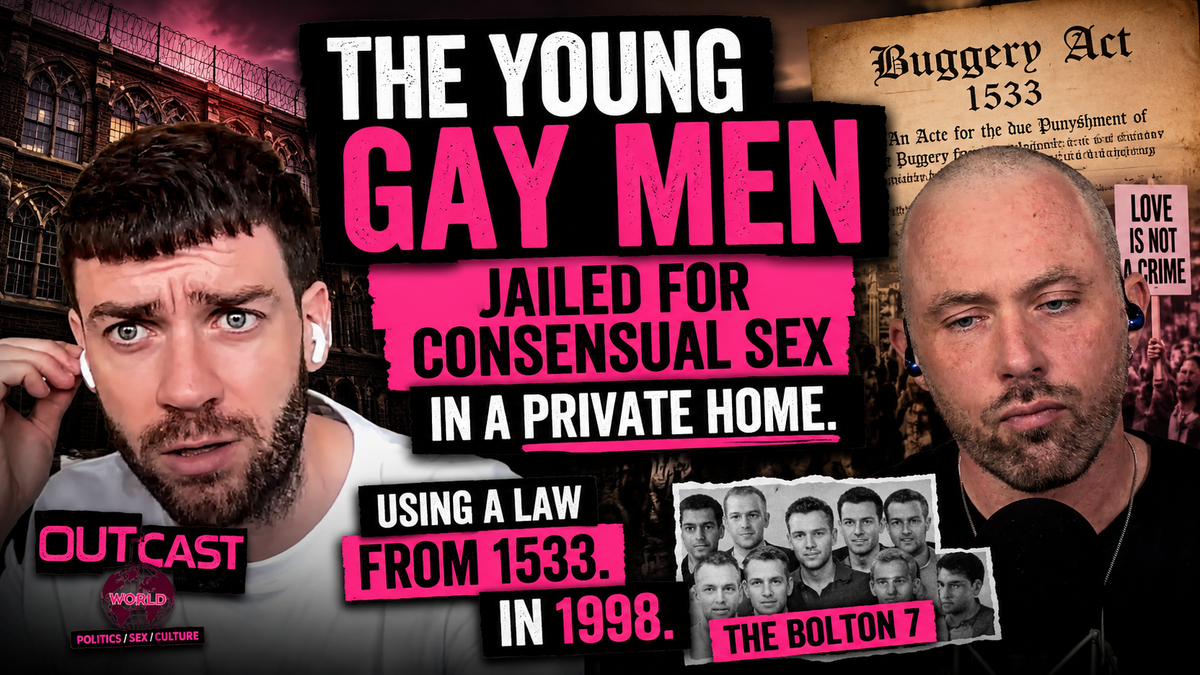
There is a moment in the first episode of Tip Toe, Russell T Davies' new drama for Channel 4, where the Bolton Seven get a mention. Alan Cumming's character, Leo, the owner of a gay bar on Canal Street in Manchester, reels off a list of injustices. Section 28. The Bolton Seven. For most viewers it will pass in a blink. A name in a list. Background texture in a story about the present.
It shouldn't. Because the Bolton Seven are not background texture. They are one of the most significant and most buried miscarriages of justice in modern British LGBTQ+ history, and the fact that a Russell T Davies drama in 2026 is the closest most people will come to hearing about them tells you everything about how thoroughly this case was allowed to disappear.
This episode of Outcast World is an attempt to change that.
What happened
On 12 January 1998, seven gay and bisexual men were convicted at Bolton Crown Court of buggery and gross indecency. The sex they had been prosecuted for was entirely consensual. No complaint had been made. It had taken place in a private home. There was no victim in any meaningful sense of the word.
Some of the men received custodial sentences. All of them were placed on the sex offenders register, a register introduced just months earlier under the Sex Offenders Act 1997, a piece of legislation that grouped their convictions alongside offences involving children. They were working-class men from Greater Manchester. One worked in a factory. Several were unemployed. The youngest was seventeen years old.
The law used to convict five of them, gross indecency, was the same statute used against Oscar Wilde in 1895. The law used against three of them, buggery, dated from the Buggery Act of 1533, enacted under Henry VIII. These were not obscure legal curiosities being dusted off by an eccentric prosecutor. They were the operative legal framework for gay men's lives in Britain in 1998, even if most of the country had quietly stopped noticing them.
The legal architecture of the injustice
To understand how this was possible, you need to understand what decriminalisation actually meant in Britain, because the word is doing a great deal of heavy lifting and most of it is dishonest.
The Sexual Offences Act 1967 is routinely described as the moment homosexuality was decriminalised in England and Wales. What it actually did was considerably narrower. It permitted sexual acts between two consenting adult men in private. Two. Not three. Not seven. And private meant something specific and punishing: a privately owned home, doors locked, windows shut, nobody else present. Not a bedsit. Not a rented room. Not technically a hotel.
The age of consent was set at 21 for gay men, five years higher than the heterosexual age of consent. It was lowered to 18 in the early 1990s but remained unequal. In 1997, when the sex that led to the Bolton Seven's convictions took place, a seventeen-year-old could legally have sex with a woman. He could not legally have sex with a man. That single disparity opened the door to the entire prosecution.
And the two-man rule meant that what the Bolton Seven did, having sex together as a group in a private home, remained a criminal act regardless of consent, regardless of privacy, regardless of the absence of any harm to anyone. Straight people have always had group sex. The law simply did not care. It was only gay men who could be convicted of gross indecency, a deliberately vague and infinitely elastic term that police forces used, as Hugh Sheehan puts it in this episode, entirely according to their own whims.
Greater Manchester Police
The Bolton Seven did not happen in a vacuum. They happened in a specific city, policed by a specific force, with a specific history.
Until 1991, Greater Manchester Police had been led by Chief Constable James Anderton, a man whose public statements about gay men, people with AIDS, and sex workers were so virulently hostile that they would be considered hate speech by any modern standard. Anderton ran an aggressively homophobic force for well over a decade, actively encouraging the prosecution of what he called deviant behaviour. His retirement in 1991 did not immediately transform the culture he had built.
By 1997 the force had a new chief constable and an active initiative to repair its relationship with Manchester's queer community. And yet somewhere in the Bolton division of Greater Manchester Police, someone decided to pursue seven working-class gay men for a private sex party with a thoroughness that was not being replicated anywhere else in the country. The arresting officer never spoke to Hugh Sheehan. The prosecutor never spoke to Hugh Sheehan. The question of why this happened with such unusual zeal in Bolton in 1997 remains, formally, unanswered. It is one of the most troubling loose ends in the story.
Class and the law
Hugh Sheehan makes a point in this episode that deserves to be repeated plainly. The legal definition of privacy under the 1967 Act, the privately owned home, doors locked, nobody else present, was always going to fall hardest on people without access to those kinds of spaces. The middle classes, men with their own homes and their own rooms and their own doors to lock, had a structural advantage baked into the legislation itself. Working-class gay men, men in bedsits and council houses and rented rooms, were always going to be more exposed.
The Bolton Seven's sex happened in a council house. Technically, under the interpretations being applied by some forces at the time, that was not a private residence in the required sense. At every point in the process, from the initial prosecution to the courtroom itself, these men were navigating institutions that were not designed for people like them and were not inclined to treat them with fairness. As Sheehan observes, class follows you all the way to the mattress.
New Labour and the delay that cost people
Tony Blair's government came to power in May 1997 on a wave of optimism that extended, cautiously, into questions of LGBTQ+ equality. The age of consent campaign had been running for years. Section 28 was on the list of things to address. And yet the Sexual Offences Act that finally abolished gross indecency and the two-man rule, the laws used against the Bolton Seven, did not reach the statute book until 2003. Five years after the convictions. Five years during which those same laws remained available to any police force or prosecutor inclined to use them.
Jack Straw's attempts to attach age of consent equalisation to earlier legislation were blocked by the House of Lords, twice, eventually requiring the government to invoke the Parliament Acts to force the measure through. The incrementalism of the process is understandable in one light and indefensible in another. Men were being convicted, and in some cases imprisoned, under laws the government knew needed to change. The Bolton Seven were not an aberration. They were a consequence.
Where it stands now
The Sexual Offences Act 2003 abolished gross indecency as an offence and removed the stipulation that sex between men had to involve only two people. The age of consent had been equalised in 2001. These were genuine advances. But the situation for men convicted under the old laws is not clean.
Since 2012, men convicted of buggery and gross indecency have been able to apply for their convictions to be formally disregarded under the Protection of Freedoms Act. Only once a conviction is disregarded can a pardon be sought. Only once a pardon is granted does the state formally acknowledge the wrong. And there are categories of conviction, men who had sex in public toilets, often the only available private space in an era when gay men had nowhere else to go, where the acts involved remain criminal offences and no disregard is possible. Those men are still carrying their convictions. The ledger is not settled.
Why it matters now
Russell T Davies did not make Tip Toe as a period drama. He made it as a warning. The hostility it depicts, the radicalisation of prejudice, the normalisation of violence against gay men, the creeping retreat of rights that were never as secure as they felt, is the world he sees around him. He is not wrong.
The rhetoric used against gay men in the 1990s, the contagion model of queerness, the predation narrative, the moral panic around children and sexuality, has not disappeared. It has migrated. Much of it now targets trans and gender non-conforming people. Some of it is targeting gay men again, more quietly, through the backlash against what is dismissively called the gay agenda in schools, through the resurgence of conservative moral panic about what children should be allowed to know.
Hugh Sheehan made Criminally Queer because he is a young queer man who understands, viscerally, that the rights he has are not permanent. The Bolton Seven are not a cautionary tale from another era. They are a reminder of what the state is capable of when it decides that a particular group of people's private lives are a matter of public order.
Seven men. A private home. Consensual sex. A law from 1533.
In 1998.
Criminally Queer: The Bolton 7 by Hugh Sheehan is available now on BBC Sounds, Spotify, and Apple Podcasts.