Is Max Parker the New Russell Tovey? And Does British Gay Talent Even Need a Successor?
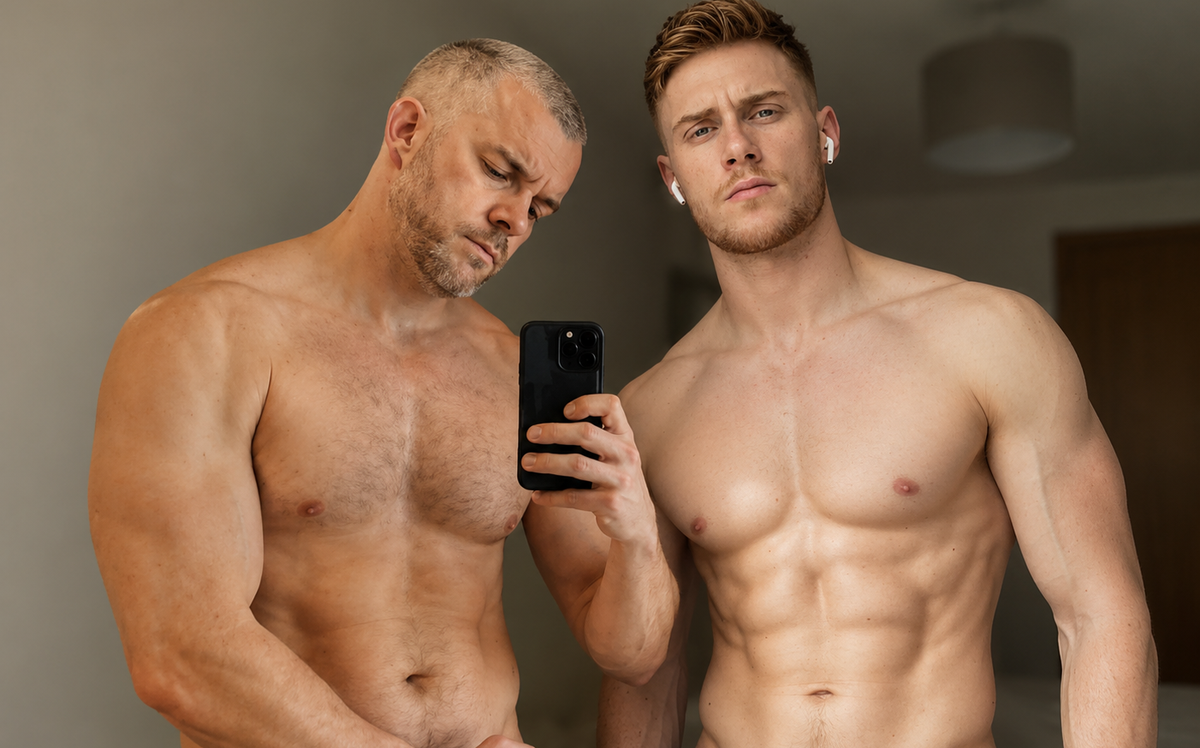
There is, in the machinery of British entertainment journalism, a compulsion to anoint. Someone must always be the next someone else, the heir apparent, the torch-bearer for a community that never actually asked for a single representative in the first place. For the best part of a decade, Russell Tovey has been the default answer to the question "name a successful, openly gay British actor who works on both sides of the Atlantic." And now, with the momentum building behind Max Parker following his breakout in Netflix's Boots and a God of War casting that would make most actors' agents weep with joy, the comparisons have started in earnest.
The parallels are, on the surface, almost too neat. Both are working-class northern-adjacent lads (Tovey from Essex via an aspirational coach-service family, Parker from Bolton) who came up through British institutions before crossing over to American prestige television. Both came out publicly in interviews with Attitude magazine. Both have played the Doctor Who universe. And both have spoken, with varying degrees of elegance, about the tension between being an openly gay actor and the roles the industry will or won't offer you.
Parker himself has never been shy about the comparison. In his 2020 coming-out interview with Attitude, he was direct about it: "Russell Tovey has been a big inspiration for me; seeing a gay man do so well and being so versatile in his characters." That kind of public acknowledgement matters, not because Parker needed permission to exist, but because it traces a lineage. Tommy DiDario, interviewing Parker for his iHeart podcast ahead of Boots' release, noted the similarities explicitly, telling Parker there were "a lot of similarities I see between the two of you" and that he could see "a very similar parallel there," to which Parker responded with characteristic good humour rather than any attempt to distance himself from the association.
But where the comparison gets genuinely interesting, and where any future tension could theoretically brew, is in how differently the two men have navigated the politics of being gay in public.
Tovey, for all his considerable talent and range, carries the scar tissue of his 2015 Guardian interview, in which he told Tom Lamont that he was grateful his father hadn't sent him to theatre school because he might have ended up "really effeminate," adding that he thanked his dad "for not allowing me to go down that path." The backlash was swift and brutal. He later reflected with Metro that the episode had been "a very upsetting time" and that he "never meant to upset anyone," conceding that "things come out the way you don't intend them to." He added, with the wearied pragmatism of someone who has been through the social media mangle, that he had "learned a lot from it" and grown, and that it had made him "feel more impassioned about my responsibility, which I took for granted."
Parker, by contrast, has moved through the discourse with a lighter touch, perhaps because he arrived a generation later, perhaps because his own coming-out story, which involved seven years in a relationship with a woman before accepting his sexuality, gives him a different vocabulary for talking about identity. He told Attitude in 2020 that "there did come a point maybe about a year later where I thought, from now on I don't think I can imagine myself being with a woman. Something in my mind just changed." There is a gentleness to that phrasing, an absence of the muscular defensiveness that characterised Tovey's public wrestling with masculinity.
On the question of gay actors and gay roles, Parker has been thoughtful without being sanctimonious. Speaking to Imagine Magazine, he said that "queer stories are important" and that while he had been "moved by performances like the ones seen in Call Me By Your Name, both played by straight men, it's about finding the person who can tell the story best and tell it truthfully and authentically." He went further, noting plainly that "queer artists should be given more opportunity to play queer roles. There are so many of us, why wouldn't we be chosen?" On DiDario's podcast, he was equally candid about the industry dynamics, observing that "there's a lot more members of our community that are playing lead roles as straight or gay, and then a lot of gay actors that I guess do a lot of gay work. Whether that's because they want to, they feel it's important to do that, or whether they're being pigeonholed, I don't know."
And this is where the trajectories genuinely diverge. Tovey spent the first decade of his career playing almost exclusively straight roles, from the beloved slacker Steve in Him & Her to the werewolf George in Being Human, before taking on gay parts in Looking and The Pass. He told The Scotsman in 2014 that he had been waiting for something substantial "that really moves things forward" before taking a gay role, having already established himself as a versatile leading man. Parker, meanwhile, broke through internationally playing a closeted gay drill sergeant, and is now moving in the other direction, from Boots to playing the Norse god Heimdall in Amazon's God of War adaptation, a role that has nothing to do with sexuality and everything to do with physicality, charisma, and screen presence.
Could there be beef? In the traditional celebrity rivalry sense, almost certainly not. They occupy different generational slots, and there is no evidence they have ever been in direct competition for the same role. Tovey, at 44, is writing screenplays (he penned and will star in Wild Bird, a short about Alexander McQueen and Isabella Blow, directed by Andrew Haigh and co-starring Olivia Colman), hosting Talk Art with gallerist Robert Diament, and moving into a phase of his career defined as much by creative producing as by acting. Parker, at 34, is in the pure accumulation phase, stacking credits and building the kind of range that makes casting directors pick up the phone. Both have appeared in Doctor Who, the great equaliser of British acting CVs. Both have worked in Ryan Murphy's orbit, Tovey through American Horror Story: NYC, Parker through the Netflix ecosystem that Murphy helped shape. The Venn diagram overlaps, but the men are not fighting over the same circle.
Where it gets more provocative, and where anyone building content around this narrative should pay attention, is in the broader question of what British gay male talent actually looks like in 2026, and whether the Tovey model of "come out quietly, play straight, eventually take a gay role" has been superseded by the Parker model of "come out, play a landmark gay role, then prove your range." The industry has shifted. The pipeline has shifted. And the conversation about who gets to represent whom, and on whose terms, has shifted with it.
If anything, the more interesting dynamic is not Parker versus Tovey but Parker alongside Tovey, two data points on a curve that is, slowly and imperfectly, bending toward something that looks a lot like ordinary career progression for talented actors who happen to be gay. The fact that we can even frame it that way, rather than as a story of courageous exception, is itself the point.