Protein powder, swastikas, and the Burnham question: performed masculinity, moral common sense, and the Labour party
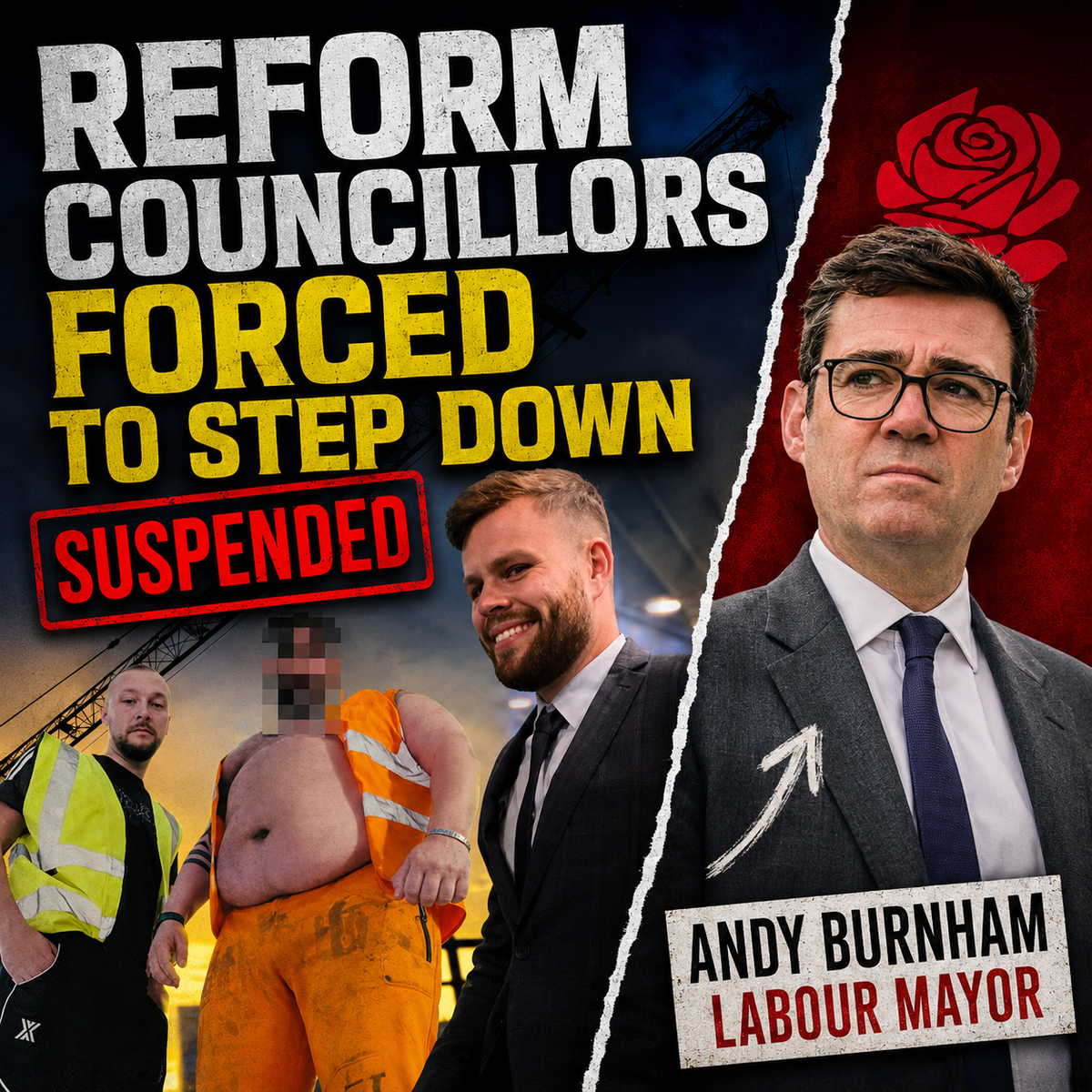
Something is fracturing across British public life, and it is happening simultaneously in places that are supposed to have nothing in common. The political party that markets itself as moral common sense is haemorrhaging freshly elected councillors over social media posts sympathetic to Nazi imagery and, separately, undisclosed careers in gay porn. The manosphere influencers who built audiences on hyper-aggressive masculinity are unravelling under the gentlest journalistic scrutiny imaginable. And the governing party appears to be sleepwalking through its own post-mortem phase while a former mayor quietly positions himself as the last credible figure standing.
None of these stories are technically connected. All of them are fundamentally about the same thing: performance, the absence of substance behind it, and what happens when even minimal public scrutiny arrives.
Start with Reform UK, whose vetting process has now become something approaching a national comedy of errors. According to analysis by Byline Times, more than thirty newly elected Reform councillors face allegations of wrongdoing, hypocrisy, or sharing hateful material, with at least four already suspended, expelled or resigned within days of the May 2026 local elections. Mark Pack's widely cited tracker of Reform councillor departures records that by April 2026, at least 44 councillors elected in 2025 had already left the party through resignation, expulsion, or defection, and the 2026 intake appears to be following an identical trajectory at an accelerated pace.
The specifics are extraordinary. In Sunderland, councillor Glenn Gibbins was suspended after a Facebook post emerged in which he allegedly suggested the city's Nigerian community should be "melted down" to fill potholes. In Sefton, Jay Cooper was expelled after reports surfaced of him describing the Holocaust as a hoax. In Essex, Stuart Prior resigned from two council seats and had his membership revoked over alleged racist and Islamophobic posts, including claims that white people are "the master race," which had been flagged by the campaign group Hope Not Hate. In Plymouth, Ben Rowe was suspended after posts including an image depicting a SpongeBob character as a Muslim with a child bride were uncovered. In Sheffield, Nathaniel Menday was suspended for sharing pictures of swastikas and Adolf Hitler's Mein Kampf.
And then there is Stephen Mousdell, the newly elected councillor for Haydock in St Helens, whose parallel career as a gay adult performer under the name "Lachlan Taylor UK" was exposed by LBC. Mousdell resigned, but not before issuing a statement that was, in its own way, far more honest than anything the party managed. "I was told to apologise to the public and stop doing what I was doing if I was in for a chance of staying being a councillor," he said, "but I refused because I have done no wrong doing and I'm not lying just to stay in office. I am, who I am." Reform's official line was that his "lifestyle choices" were a private matter and that he had "not broken the law." The gap between the party's public tolerance and its private pressure, as The Daily Britain noted in its coverage, raises pointed questions about whether Reform's libertarian posture on personal freedom is anything more than a convenience.
The pattern is consistent and structurally damning. The party constantly markets itself as the last line of moral common sense while simultaneously attracting candidates who collapse under basic public scrutiny within about forty-eight hours of election.
Which brings us to the manosphere, where the collapse looks different in texture but identical in principle. Louis Theroux's Netflix documentary Inside the Manosphere, released in March, has done more to dismantle the credibility of the movement's loudest voices than years of outraged commentary ever managed, largely because Theroux barely needed to push. Harrison Sullivan, better known as HSTikkyTokky, told Theroux's cameras with remarkable candour that his entire persona was a commercial exercise. "Call me racist, call me a misogynist, call me homophobic, call me a scammer," he said. "I'm all those things." He then confirmed that he would "disown" his son if he were gay, before insisting he was not homophobic. Speaking to Wired, Theroux reflected on the most revealing moments coming when the cameras were rolling but the livestream was off, and Sullivan gave "considered answers to questions about why he does what he does."
The whole ecosystem just looks fundamentally fraudulent once you see it clearly. Aggression masquerading as ideology. Empty dominance rituals performed for lonely young men online who mistake volume for authority.
And then there are the Grindr stories. Across multiple countries, young men aligned with exactly this culture of performed hyper-masculinity have been convicted of using fake profiles on gay dating apps to lure men into meetings before assaulting them and distributing the footage as content. In New Zealand, three men who called themselves "paedophile hunters" received home detention sentences after courts ruled their attacks were hate crimes targeting gay men, not vigilante justice. Judge Stephen Coyle was explicit: he could not divorce the rhetoric from the reality. "It was the targeting of gay men," he said, "and the clear conclusion I have reached is that this was a hate crime." Similar prosecutions have followed in the UK, Australia, and Spain, in each case following the same model of weaponised dating apps and filmed humiliation.
When your entire public identity revolves around policing other people's sexuality, the internet is obviously going to notice contradictions very quickly. And when scrutiny does land on these figures personally, suddenly nuance exists again. Old phone. Former employee. Somebody else's account. Fine. Maybe. But these lads talk professionally for a living. That is the business model. Everything is content. Everything is outrage. Everything is performance. Until scrutiny lands on them. Then suddenly complexity is real.
All of which plays out against a backdrop of genuine political consequence. Andy Burnham, approved by Labour's National Executive Committee to stand in the Makerfield by-election on 18 June, now represents perhaps the only plausible route back for a party that has lost its grip on northern England so comprehensively that Reform won every single council ward in the Makerfield constituency in May's local elections with roughly fifty per cent of the vote. Ben Walker, writing in the New Statesman, described it as potentially "one of the most totemic and decisive parliamentary by-elections in modern British history." Channel 4 News called it "arguably the most important by-election in living memory." A Survation analysis suggests Burnham's personal popularity could deliver a narrow Labour hold, perhaps by three points, but without him the seat would almost certainly fall to Reform.
And hovering behind all of it is the question of whether the system itself can survive what is happening to it. George Monbiot, writing in the Guardian in February, laid out the arithmetic bluntly: on just twenty-seven per cent of the national vote, Reform could win forty-eight per cent of parliamentary seats under first past the post. That is not a fringe scenario; it is a polling-based projection. Monbiot has spent years arguing for progressive alliances and proportional representation, and the case has never been more viscerally obvious. Former Green Party leader Caroline Lucas has publicly called on the Greens to stand down in Makerfield to avoid splitting the anti-Reform vote, an acknowledgment that the old tribal lines are becoming irrelevant in the face of what is actually at stake.
Because once Reform starts breaking the traditional system, everybody starts realising the traditional system might not survive intact. The councillors who last a fortnight. The influencers who admit on camera it is all a grift. The governing party that cannot find a convincing reason for its own existence. These are not separate crises. They are the same crisis, viewed from different angles. And the only people who seem not to have noticed are the ones still performing as if nobody is watching.