Tip Toe and Durham Pride: by Graeme Smith
Russell T Davies has made a drama about how easily an ordinary man is turned into an enemy. In County Durham, a Reform-run council has shown how easily a community is told it is no longer welcome. The two stories arrived within days of each other, and read together they point to the oldest answer we have says OUTCAST WORLD'S Graeme Smith.
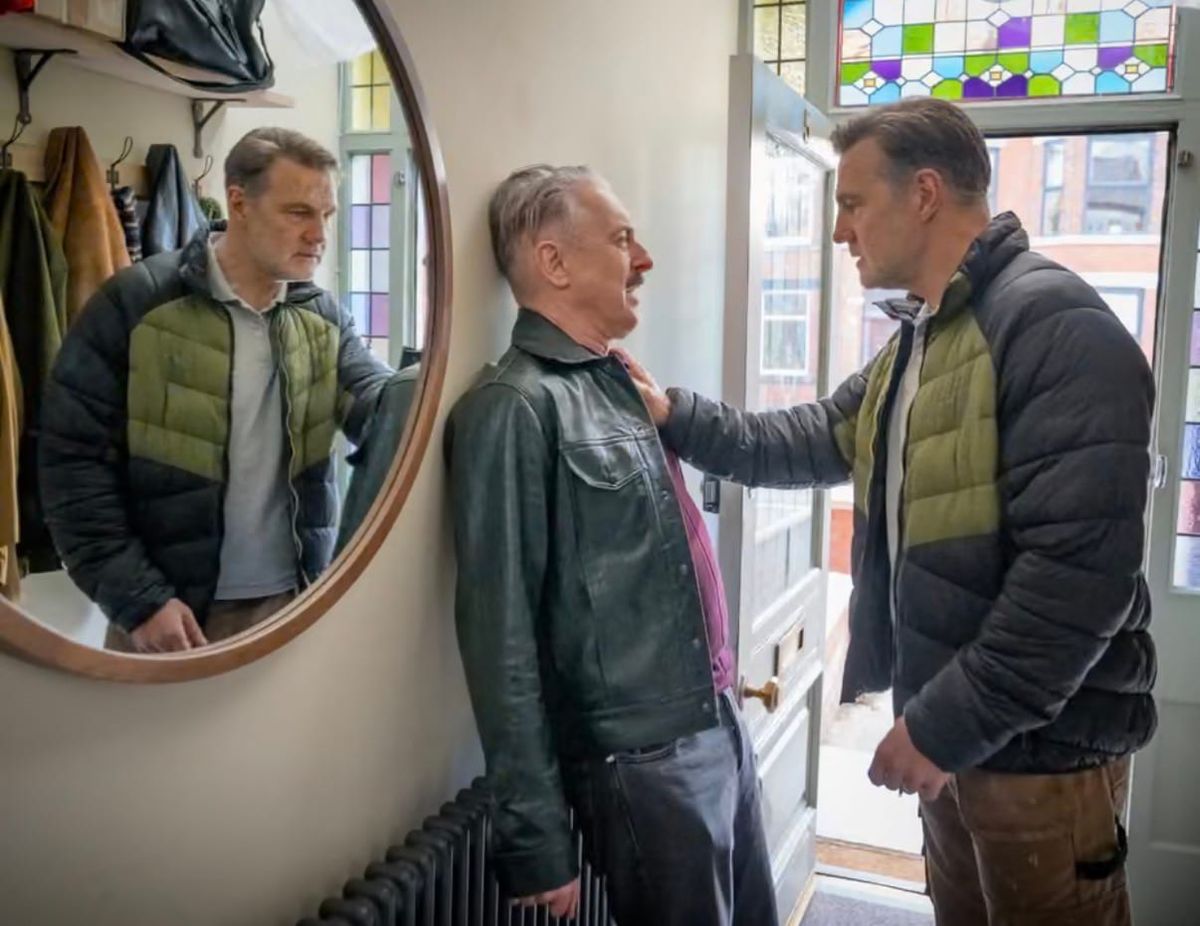
There is a moment near the beginning of Russell T Davies's new Channel 4 drama that is so small it would be easy to miss its weight. Leo, the warm and quick-witted owner of a bar in Manchester's Gay Village, hands his neighbour Clive a key to his front door. It is the kind of thing people who have lived beside each other for fifteen years do without thinking, a gesture that says nothing more complicated than I trust you, water my plants, take in the parcels. In Tip Toe, it is the hinge on which everything turns. From that one courtesy the relationship begins to rot, and by the close of the five episodes two men who once nodded at each other over the wheelie bins have become deadly enemies in a way that leaves nobody around them safe. Davies has described it as a story in which no good deed goes unpunished, and the early notices suggest he has made the angriest and most frightening thing of his career, with the Telegraph calling it a stirring warning against hate and the Independent describing it as a landmark queer drama.
What lifts it above the usual register of state-of-the-nation television is that Clive, played by David Morrissey with the kind of unsmiling restraint that is far more disturbing than shouting, is not a monster sketched for us to boo. He is recognisable. He is the man who has come to doubt everything the established powers tell him and to believe almost anything posted in opposition to them, the man whose private sense of grievance is found, fed and slowly shaped by an online machinery built for precisely that purpose, until a vague resentment has hardened into something with a direction and a target. The genius of the writing, and of Peter Hoar's direction, is to show how little it takes and how quietly it happens. Clive is not radicalised by a rally or a recruiter. He is radicalised alone, in a suburban house, with a screen for company, and the tragedy the drama keeps circling is that nobody ever stood between him and the thing that was working on him.
It is worth remembering what Davies has done with this canvas before, because Tip Toe sits in a line of work that has been quietly mapping the country's anxieties for two decades. There was Queer as Folk, which put unapologetic gay life on Channel 4 when that was still treated as a provocation. There was It's a Sin, his devastating account of the AIDS years and the young men London chose not to mourn. There was Years and Years, a near-future in which an ordinary British family watched their settled world tilt by degrees into something authoritarian, the horror arriving not as a coup but as a series of reasonable-sounding adjustments. Tip Toe brings that same lens to the present rather than the past or the future, and trains it on the creeping return of a hostility many of us had allowed ourselves to believe was in retreat. The discomfort it has produced in viewers is not incidental. It is the point. Davies has made a drama about the present tense, about the precise mechanism by which a tolerant-enough society talks itself back into intolerance, and he has set it not in some imagined dystopia but on a street that could be anyone's.
The reason the drama lands with such force this particular spring is that the country has been supplying him with material. While Tip Toe was being edited, a real version of its argument was playing out two hundred miles to the north, without a script and without the dignity of fiction.
In County Durham, the local authority has withdrawn its long-standing contribution to Durham Pride, an event that has run since 2014 and grown, at its height, to draw something close to twenty thousand people across the county. The headline figure is almost insultingly small. The council's annual contribution had been two thousand five hundred pounds, topped up in the previous year by a further ten thousand drawn from money the county had been awarded as part of an unsuccessful City of Culture bid. These are not sums that decide a council's solvency, and the organisers have been admirably clear that the money was never really the issue. The chair of Durham Pride, Mel Metcalf, has said plainly that the two and a half thousand pounds was never the point, and that the organisation would not in any case have taken money from the authority in its current form. What was withdrawn, in other words, was not a budget line but a welcome.
The withdrawal came from the council's Reform UK administration, and its deputy leader, Darren Grimes, framed it in the now thoroughly rehearsed language of the culture war, announcing that Pride would not be getting a single penny from the council and that the money would go instead to roads and bins and the services he characterised as the proper business of local government. Pride, in his telling, had long ago stopped being a celebration of gay rights and become a vehicle for ideology and activism that he, as a gay man, wanted no part of. It is a clever piece of rhetoric, because it allows a deliberate act of exclusion to dress itself in the sober clothes of fiscal responsibility, and it invites everyone else to treat the matter as a minor question of accountancy rather than what it is.
What it is becomes clear the moment you place Durham alongside everything else Reform has done with the councils it now controls. This is not an isolated decision by one administration with one set of local priorities. Across the ten English councils the party took in 2025, Pride flags have come down from civic buildings to be replaced by national and county colours, equality and inclusion teams have been renamed or dismantled, and the party's chairman cheerfully described the councils as the place where diversity and inclusion would go to die. Nigel Farage warned staff working on equality initiatives to find other careers quickly. In Staffordshire the council simply refused to fund Pride. In Leicestershire the new administration's first act was an emergency meeting about a flag. The Durham cut is not a quirk of County Durham. It is a template, applied with discipline, and its purpose is not really to save two and a half thousand pounds. Its purpose is to send a signal, to a particular group of people, that the public realm is no longer quite theirs.
And here the story turns, because the signal was answered.
When the funding was pulled, the trade union movement in the county closed ranks around the event in a way that ought to have surprised nobody who knows the region's history and clearly surprised the administration that triggered it. The TUC and the Durham Miners' Association ran a fundraiser that brought in more than the council had taken away. Equity, the union for performers and other creative workers, added a further seven thousand two hundred pounds, presented at a ceremony in the Miners' Hall in Durham, its president telling the room that the union would not stand by and let a Pride that brings work to its members and celebrates its performers be killed off. The total raised passed fifteen thousand five hundred pounds, several times the sum that had been withdrawn, and Durham Pride will go ahead this month larger and louder than the authority that tried to diminish it. Defunded, as the local students put it, but not defeated.
The choice of venue carries more than convenience. The Durham Miners' Hall is one of the cathedrals of the British labour movement, the home of an association whose banners and brass bands still fill the city every year for the Big Meeting, and to hand a cheque to a Pride event across its floor is to make an argument about who belongs to whom. It says that the queer community of Durham and the organised working people of Durham are not separate constituencies to be set against one another, as the culture war would prefer, but the same people, and that the labour movement regards an attack on one as an attack on all.
If that sounds like sentiment, it is worth recalling that it is also precedent, and recent enough to be living memory for many of the people in that hall.
In 1984, as the miners' strike ground through its bitter year, a small group of activists led by Mark Ashton and Mike Jackson stood on the London Pride march with collection buckets and began raising money for mining communities they had never met. They called themselves Lesbians and Gays Support the Miners, and the logic Ashton offered was disarmingly simple, that a community used to being harassed by the police and dismissed by the press ought to recognise another community in the same position and stand with it rather than wait to be asked. They formed an alliance with the mining village of Onllwyn in the Dulais Valley in South Wales, raised more for the strikers than almost any other support group, and were thanked in the most consequential way imaginable when the National Union of Mineworkers turned out in force to support gay rights, carrying their banners on the Pride march in return and pushing the Labour Party to adopt sexual equality as a formal commitment. The story was largely forgotten until the 2014 film Pride brought it back, but the people who lived it never thought of it as charity in either direction. They thought of it as solidarity, which is a different thing entirely, and the distinction is the whole point.
Charity flows downward. It is given by people who own things to people who need things, and it leaves the relationship between them exactly as it was. Solidarity flows sideways. It is what people who have only their labour and each other extend to one another in the understanding that none of them is safe alone, and it changes the relationship, because it builds something that can act. The miners did not pity the gay activists and the gay activists did not pity the miners. They recognised, correctly, that the same government and the same press and the same comfortable consensus had decided both of them were expendable, and they worked out, in church halls and union meetings and on coaches down to the valleys, how to be useful to each other. Forty years later, in the same county and very nearly the same buildings, the descendants of that movement have done it again.
This is the thread that runs through both of these stories, the televised one and the real one, and it is the reason they belong in the same piece. Tip Toe is, at bottom, a study of what happens to a man who is left alone, picked off, worked on in isolation until he becomes a danger to the people nearest him. Durham is a study of what happens when a community refuses to be left alone, refuses to be picked off, and does the unglamorous, meeting-heavy, undramatic work of figuring out how its people actually fit together and who will turn up when one of them is targeted. The first is a warning. The second is the answer to it.
I should declare an interest, because Equity is my union too, and watching its president hand that cheque across the floor of the Miners' Hall did something to me that the more polished forms of allyship never have. There were no brands attached, no campaign hashtag, no carefully focus-grouped statement of values. There was simply a body of working people deciding that another body of working people would not be abandoned, and putting money where the decision was. That is the part worth holding on to. We are not short of opponents, in committee rooms and comment sections alike, and we will not out-spend them, nor will we out-shout the machinery that turns the Clives of the world into enemies of their neighbours. What the overwhelming majority of us have instead, all of us who get up in the morning and earn the money we live on rather than living off what we already own, all of us who do not hold the means of production and never will, is each other. It is the only real power we have ever had. Durham has just reminded us, again, how much it is worth when we actually use it.