Russia’s war on LGBTQ+ people is no longer just Russia’s problem
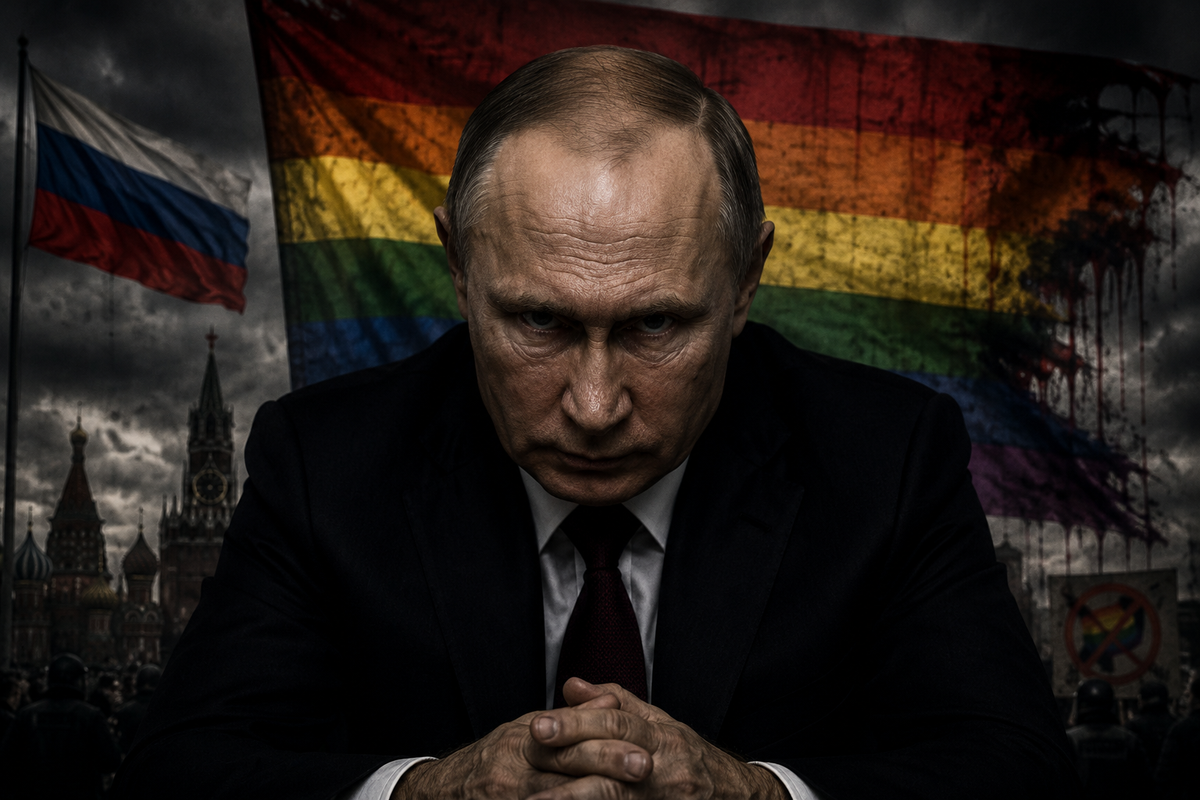
For years, many liberals in Western Europe comforted themselves with the idea that Russia’s anti-LGBTQ crackdown belonged to a different political universe entirely, something uniquely post-Soviet and culturally specific, shaped by authoritarian nationalism, Orthodox conservatism and Vladimir Putin’s obsession with rebuilding a wounded imperial identity. It was viewed as brutal, certainly, but also distant. Britain, America and much of Western Europe liked to imagine themselves safely beyond that kind of politics, too institutionally mature and culturally liberal to slide backwards into open hostility toward queer people again.
That confidence now looks dangerously naive.
Because what Russia understood earlier than much of the democratic world is that modern authoritarianism does not begin with mass arrests or dramatic legal ruptures. It begins with atmosphere. It begins with the steady emotional conditioning of a population until minority groups no longer feel like neighbours or fellow citizens but symbols of national decline, social disorder and cultural collapse. The real political battle is not over policy detail but over mood, repetition and narrative. Once a society emotionally accepts the idea that a minority represents danger, almost anything becomes politically possible afterwards. Recent reporting from PinkNews on Russia’s expanding anti-LGBTQ extremism laws illustrates exactly where that process eventually leads, with activists warning that queer Russians are now living under conditions of fear so pervasive that even social media activity, clothing choices or vague public expressions of identity can attract state attention. (Al Jazeera)
The case involving a man reportedly threatened with deportation proceedings after reviewing a leather skirt online would once have sounded surreal, almost comic in its absurdity. But absurdity is often part of the mechanism. The purpose of modern illiberal politics is not simply punishment. It is psychological destabilisation. Citizens are meant to internalise uncertainty until they no longer know where the boundaries truly are. Fear becomes ambient rather than episodic. People censor themselves long before the state ever formally intervenes.
Russia did not arrive at this point suddenly. The infamous “gay propaganda” laws introduced under Putin in 2013 were initially defended in the language of child protection and cultural stability. Supporters insisted nobody was criminalising homosexuality itself, merely restricting inappropriate ideological influence around minors. It sounded measured enough for many outsiders to shrug at initially. Yet over the following decade those laws steadily metastasised outward until virtually any visible expression of queer existence became politically suspect. Books disappeared. Pride events vanished. Journalists faced pressure. Activists fled the country. LGBTQ identity itself became rhetorically intertwined with extremism and foreign subversion.
The important point is not simply that Russia became more repressive. It is how familiar the rhetorical pathway now feels elsewhere.
Donald Trump’s movement in the United States increasingly operates through precisely the same emotional architecture. The vocabulary differs slightly, the aesthetics are more digital and decentralised, but the underlying logic is strikingly similar: a society allegedly under existential threat from “gender ideology”, vulnerable children supposedly endangered by liberal institutions, and a tiny minority transformed into the symbolic explanation for national anxiety. Under Trump’s second administration, anti-trans politics has evolved far beyond campaign messaging into something approaching governing doctrine, with restrictions on healthcare, educational policy, military service and identity documentation increasingly woven into the machinery of the state itself. (Crawley LGBTQU+)
What makes this political ecosystem especially powerful is that it no longer relies primarily on formal political institutions or traditional media. Instead it operates through an enormous online emotional feedback loop driven by podcasts, livestreams, influencers, algorithmic outrage and endless pseudo-conversational content. The Joe Rogan universe sits near the centre of this atmosphere, not because Rogan himself explicitly advocates authoritarianism, but because his wider ecosystem continuously reinforces a worldview in which trans people are framed as socially destabilising, suspicious or culturally threatening. Across hundreds of hours of manosphere-adjacent content, audiences absorb the same emotional cues repeatedly: modern masculinity is under attack, institutions are lying, liberalism has gone too far, queer politics represents elite overreach, and ordinary people are finally “fighting back”.
Most consumers of this material would never describe themselves as extremists. That is partly why it works.
The audience is not being radicalised through explicit ideological manifestos but through ambient emotional conditioning. Suspicion becomes instinctive. Empathy erodes gradually. Eventually trans people cease to appear as individuals at all and instead become abstract symbols inside a wider culture war narrative.
This is why incidents involving violence or social breakdown become politically useful so quickly. In the aftermath of cases involving trans perpetrators or alleged perpetrators, large parts of the American right-wing media ecosystem now respond almost automatically by presenting trans identity itself as explanatory, regardless of wider context, mental health factors or statistical reality. The case involving Renee Good became folded directly into that narrative architecture, not as an isolated tragedy but as evidence supporting a pre-existing ideological framework in which trans people are portrayed as dangerous, unstable or socially corrosive. Facts matter less than emotional reinforcement. The point is to strengthen the atmosphere.
And once that atmosphere hardens sufficiently, state power follows naturally afterwards.
This is why Viktor Orbán mattered so much inside Europe for so long. Hungary under Orbán effectively functioned as a laboratory for illiberal democracy within the European Union itself, demonstrating that an EU member state could steadily erode liberal norms, attack LGBTQ rights, undermine judicial independence and weaponise nationalism while still benefiting economically and politically from EU membership. Orbán spent almost a generation holding the European project hostage, repeatedly blocking collective action, aligning rhetorically with Putin and exporting anti-LGBTQ political strategy across the continent. Hungary’s anti-LGBTQ laws became reference points for right-wing movements elsewhere, particularly around the framing of queer visibility as child endangerment. (Al Jazeera)
That is why Orbán’s removal from power this year matters far beyond Hungary itself. After sixteen years dominating Hungarian politics, his defeat by Péter Magyar represented not merely an electoral transition but a symbolic crack in the broader international illiberal movement that Orbán helped legitimise. (Reuters) For years, figures across the American and European right treated Hungary as proof that liberal democracy could be hollowed out gradually from within while retaining democratic aesthetics on the surface. Orbán’s model inspired conservatives globally because it showed how culture war politics could be transformed into permanent governing infrastructure.
His defeat therefore disrupted something psychologically important: the sense of inevitability surrounding the global authoritarian right.
But illiberal politics rarely disappears neatly once introduced into the bloodstream of democratic societies. Britain itself now appears increasingly vulnerable to exactly this drift.
The local elections this week revealed a profoundly fragmented political landscape in which Reform UK emerged as a major national force, polling around 26 to 27 percent in some projections while capturing councils across England. (The Times) At the same time the Greens surged to historically unprecedented levels, in some areas pushing toward 19 percent and overtaking both Labour and the Conservatives among younger urban voters. Britain is no longer moving in a single ideological direction. It is polarising simultaneously from both sides.
And in polarised systems, minorities often become symbolic battlegrounds.
Reform UK increasingly mirrors many aspects of the wider international illiberal right, particularly around identity politics, anti-“woke” rhetoric and hostility toward visible LGBTQ inclusion. The party’s pledge to remove Pride flags from council buildings under its control may appear trivial to some observers, but symbolically it matters enormously. (UNISON National) Pride flags were never merely decorative objects. They functioned as signals that queer people belonged within public life and civic institutions. Their removal is designed to communicate the opposite message: that LGBTQ visibility itself is politically contentious and institutionally unwelcome.
That process has already begun in councils controlled by Reform, where Pride and Ukrainian flags have been removed or restricted while councillors attack equality frameworks and diversity initiatives as ideological excess. (UNISON National) Again, defenders insist this is simply neutrality, common sense or opposition to identity politics. But that is precisely how these shifts always present themselves initially. Illiberalism rarely arrives announcing itself honestly. It arrives wrapped in the language of fairness, order and national restoration.
The danger for Britain is not that it instantly becomes Russia. Democracies usually erode more subtly than that. The greater danger is that British politics absorbs enough of this international authoritarian mood that hostility toward LGBTQ people becomes normalised as an ordinary feature of political life again. Once parties realise culture war outrage mobilises voters more effectively than technocratic governance, the incentives become corrosive very quickly.
And social media accelerates all of it.
A generation raised inside algorithmic outrage systems increasingly experiences politics not through institutions or policy detail but through emotional tribalism. Nuance performs badly online. Fear performs extremely well. So does disgust. So does humiliation. The trans debate in Britain has already become saturated with precisely these emotional dynamics, driven less by lived reality than by endless online amplification.
Russia simply shows where this road can ultimately end if left unchecked long enough.
What began there as jokes, anxieties and “common sense concerns” evolved slowly into a political culture where queer existence itself became framed as extremism. Western democracies are not immune to that logic. In many ways, they are now reproducing it in real time, only with better branding, slicker podcasts and more sophisticated algorithms.