The Gay Asylum Panic, and What It Says About the BBC
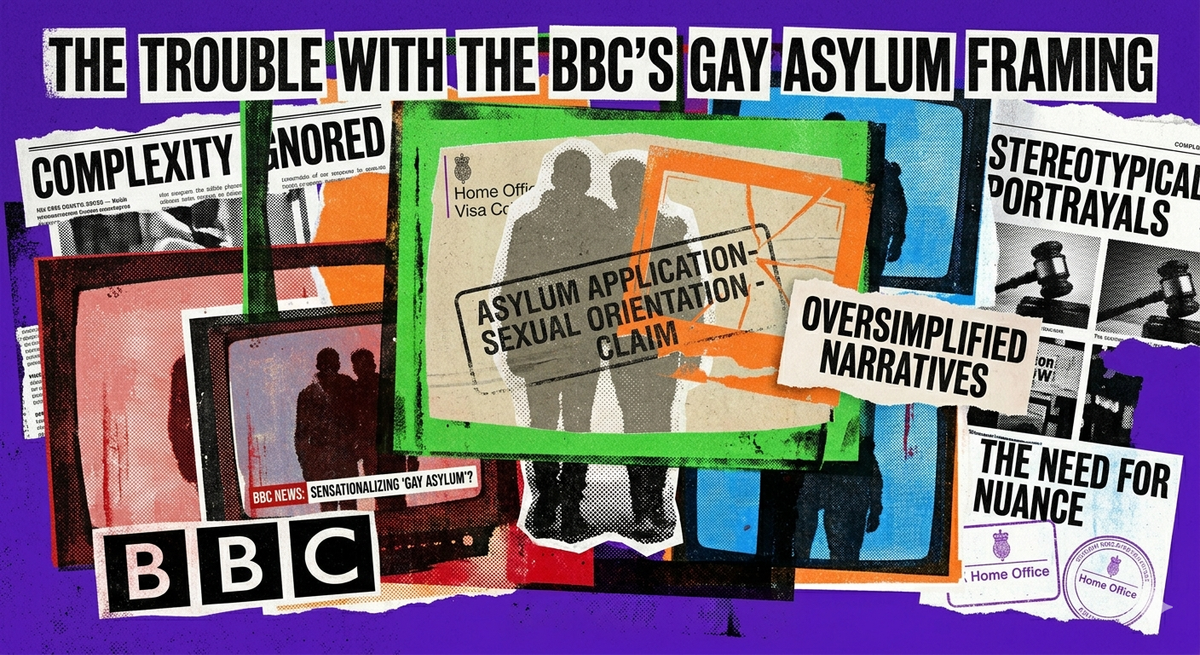
What unsettled many people about the BBC’s reporting on gay asylum claims was not simply the subject matter, nor the fact of scrutiny itself, but the unmistakable sense that a story about vulnerability had been recast as a story about doubt.
There is, after all, nothing unreasonable about reporting on asylum systems, testing evidence or asking difficult questions of public policy. But that is not quite what troubled critics here. It was the framing, the gravitational pull of the piece, the way it seemed to invite readers to approach queer asylum seekers first through suspicion rather than through the conditions that force people to flee.
That matters, because editorial framing is never incidental. It determines where empathy sits.
And in this case, empathy appeared oddly displaced.
Reading the coverage, one kept expecting the focus to settle on the brutal realities that produce LGBTQ+ asylum claims in the first place — criminalisation, blackmail, prison sentences, mob violence, the impossible demand placed on people to “prove” a sexuality that may have been lived in secrecy for survival. Instead, much of the energy appeared directed toward whether some applicants may be gaming the system, a framing that inevitably carries a broader cultural charge.
It is difficult to separate that from the atmosphere in which the story appeared. Britain has spent years steeped in suspicion around migrants, while trans people in particular have been made the permanent subject of culture-war theatre. In that context, presenting queer refugees through a lens of possible deception does not land as neutral public-interest journalism. It lands inside a much older and much more loaded set of stories about who gets believed, whose identity is thought authentic, whose suffering must be rigorously authenticated before it is taken seriously.
Those are not abstract concerns. They have a history.
There has long been a particular prejudice that casts queer identity as theatrical, opportunistic or somehow fraudulent, and one reason this report caused such unease is that some readers heard an echo of that old suspicion moving, rather comfortably, through the language of contemporary policy reporting.
That this should happen at the BBC is what gives the episode its wider significance.
A tabloid moral panic is one thing; public-service broadcasting is supposed to be another. That is why the question raised by this coverage is larger than whether one report got its tone wrong. It is whether institutions once assumed to offer ballast against reaction are beginning, consciously or otherwise, to absorb some of its assumptions.
That may sound severe, but it is not an unreasonable question. When a broadcaster treats a story about people fleeing persecution in a way many queer audiences recognise as accusatory, it is fair to ask who the framing is serving, and what instincts shaped it.
Because what has troubled many people is not simply that the BBC covered gay asylum claims, but that it appeared, however subtly, to cover them through a logic of scepticism already familiar from less reputable corners of public life.
And if that begins to feel normal, if that tone settles into the editorial mainstream as mere reasonableness, then something larger has shifted than the handling of one story. That would suggest not just a lapse of judgement, but a narrowing of moral imagination.
That, more than the story itself, is what should give pause.