US SUPREME COURT STRIKES DOWN CONVERSION THERAPY BANS
On the International Transgender Day of Visibility — a day created to celebrate the courage and resilience of trans people around the world — the United States Supreme Court chose to hand down its ruling in Chiles v. Salazar. The timing, whether calculated or coincidental, tells you everything you need to know about where America is heading.
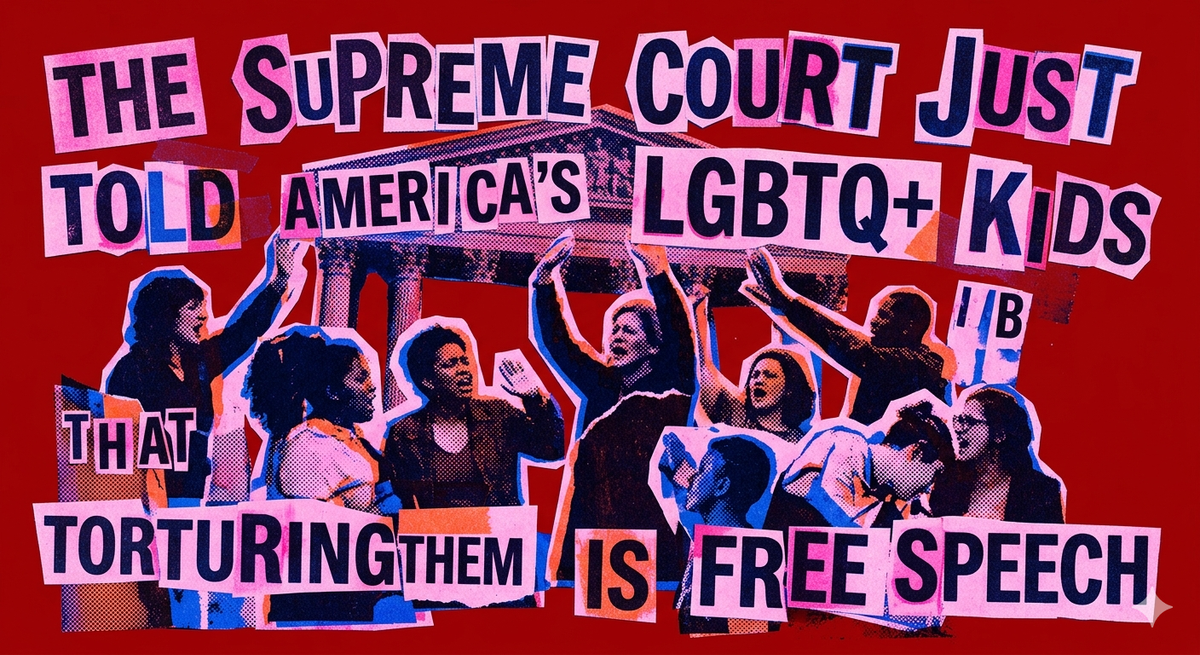
The decision, delivered 8-1 with only Justice Ketanji Brown Jackson dissenting, struck down Colorado's ban on conversion therapy for minors. The majority opinion, written by Justice Neil Gorsuch, found that the state's 2019 law — which prohibited licensed mental health professionals from subjecting children to discredited practices designed to change their sexual orientation or gender identity — violated the First Amendment. In the eyes of eight justices of the highest court in the land, telling a child that who they are is a sickness that needs curing is not abuse. It is protected speech.
Let that land for a moment. The practice that every major medical organisation in the United States has condemned. The practice that the United Nations Special Rapporteur on torture has said can amount to cruel, inhuman, and degrading treatment. The practice that at least twelve research studies have found causes depression, anxiety, substance abuse, and suicidal ideation. The practice that a study of 27,000 transgender adults found doubled the likelihood of suicide attempts. That practice is now, according to the Supreme Court of the United States, constitutionally protected free expression.
The case was brought by Kaley Chiles, a Colorado Springs therapist represented by the Alliance Defending Freedom — the same conservative Christian legal organisation that has been behind a string of anti-LGBTQ+ Supreme Court victories, including the 303 Creative case in 2023. ADF framed Chiles as a gentle counsellor who simply wanted to have open conversations with young people struggling with their faith and their identity. The reality, as researchers and survivors have repeatedly documented, is rather different. Dr Luis Alvarez Hernandez, who studies the mental health impacts of conversion therapy, warned that the ruling would lead to increased verbal humiliation, coercion, social isolation, and in extreme cases, physical violence including electrocution, forced medication, confinement, and sexual abuse. These are not hypothetical harms. These are documented outcomes of conversion therapy as it is actually practised.
And here is the part that should make every person reading this — queer or otherwise — deeply, viscerally angry. The American public does not want this. A 2019 Stonewall Anniversary Poll found that 56 per cent of Americans believed conversion therapy on LGBTQ+ children should be illegal. A majority of adults polled by The Trevor Project in 2025 agreed. This is not a divided nation being pulled in two directions by competing moral visions. This is a conservative supermajority on the Supreme Court imposing an ideological project on a country that has already rejected it.
The 6-3 conservative majority — cemented by Donald Trump's three appointments during his first term — has spent the past several years remaking American law in the image of the religious right, and the Chiles ruling is its most brazen intervention into LGBTQ+ lives yet. What makes this decision particularly dangerous is its scope. More than twenty states have conversion therapy bans similar to Colorado's. Every single one of them is now vulnerable to legal challenge. The Trevor Project, which operates the largest suicide prevention service for LGBTQ+ young people in the world, condemned the ruling in the starkest possible terms, noting that LGBTQ+ young people subjected to conversion therapy are more than twice as likely to attempt suicide. The American Foundation for Suicide Prevention said the decision put vulnerable young lives directly at risk.
The legal mechanism Gorsuch employed is worth understanding, because it reveals the strategy that the conservative movement will use again and again in the years ahead. By classifying talk therapy as speech rather than medical conduct, the majority bypassed decades of state regulatory authority over healthcare. Justice Jackson, in her lone dissent, cut straight to the absurdity: Chiles is not speaking freely in a public square; she is providing therapy to minors as a licensed healthcare professional. The distinction matters, or at least it used to. States have always had the power to regulate what licensed professionals can and cannot do to their patients. A doctor cannot prescribe a drug that has been found to cause harm simply because they believe in it. A dentist cannot pull healthy teeth because a patient's parent requests it. But a therapist can now, apparently, tell a fourteen-year-old that their sexuality is a disorder and their gender is a delusion, because to prevent her from doing so would be to censor her viewpoint.
Justice Kagan, who concurred with the majority, acknowledged that the constitutional problem with Colorado's law was what she called "textbook" but suggested that states could potentially draft narrower legislation that might survive scrutiny. It was a lifeline thrown to legislators who might want to try again. But the practical reality is that any new law will face immediate challenge from ADF and its network of conservative legal organisations, and will ultimately end up before the same court that just ruled 8-1 that conversion therapy is speech. The game is rigged, and everyone involved knows it.
What is happening in America right now is not a series of isolated legal setbacks. It is a coordinated, decades-long project to roll back the civil rights gains of LGBTQ+ people, and the Supreme Court is its most powerful instrument. In the space of a single month, Kansas has invalidated the identity documents of every trans person in the state. Kentucky is fast-tracking legislation to reclassify being transgender as a mental illness and ban trans teachers from schools. The Trump administration has stripped federal protections, defunded HIV prevention, and removed the Pride flag from the Stonewall National Monument. And now the court has told LGBTQ+ young people — the most vulnerable members of the community, the ones who are already dying at disproportionate rates — that the adults who want to torture the queerness out of them have a constitutional right to do so.
This is what a conservative supermajority looks like in practice. Not the abstract legal theory that fills the opinion pages of the Washington Post, but the lived, material consequences for real children in real therapists' offices in real states across the country. Almost three quarters of Americans oppose what is being done in their name. It does not matter. The court is unelected, unaccountable, and unmoved.
Colorado Governor Jared Polis, the first openly gay governor in American history, responded to the ruling by saying he was "evaluating" the decision and "working to figure out how to better protect LGBTQ youth and free speech in Colorado." It was a careful, measured statement. The time for careful and measured has long since passed.
Today is Transgender Day of Visibility. Today, the Supreme Court of the United States made LGBTQ+ children less visible, less safe, and less protected than they were yesterday. And somewhere in America tonight, a teenager who already feels like the world does not want them will learn that the highest court in the land agrees.
If that does not radicalise you, nothing will.